




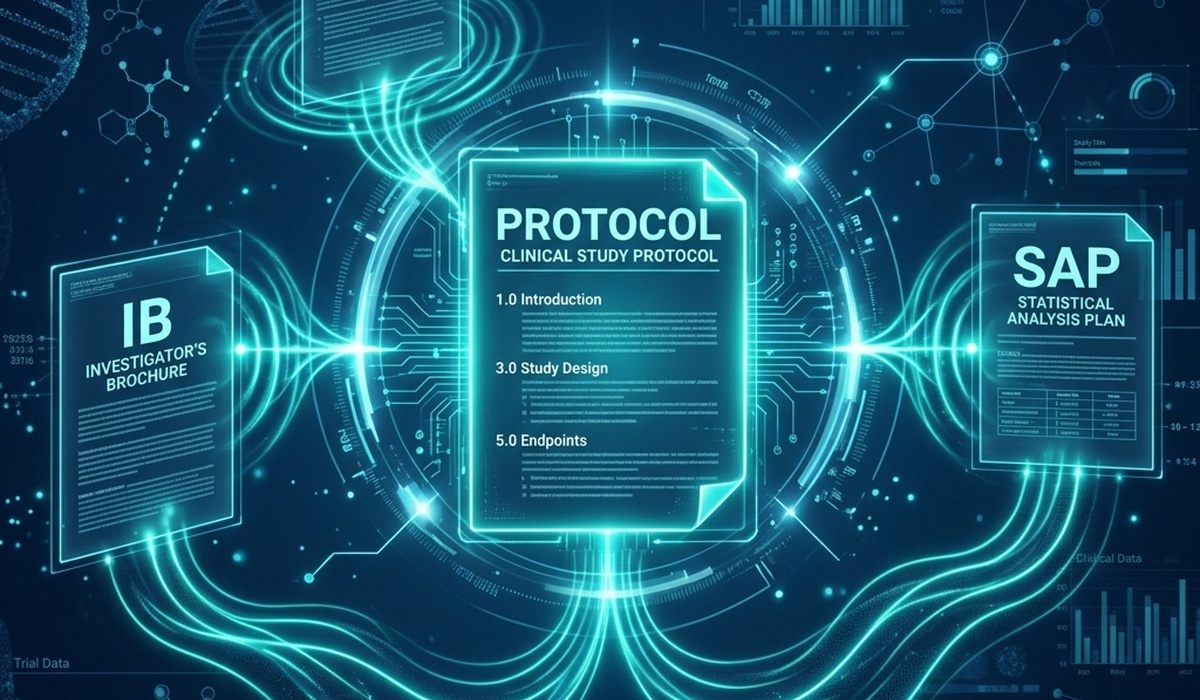
The clinical trial landscape is shifting. To increase efficiency and patient centricity, more sponsors are moving toward "adaptive" trial designs. While these designs offer incredible flexibility, they create a significant documentation headache: the constant need for Protocol & Protocol Amendments.
Every time a protocol changes, a ripple effect of updates must flow through every downstream document—from the Informed Consent Form (ICF) to the Investigator’s Brochure. In a traditional workflow, this is a manual, high-risk process. But with an AI writing solution like AuroraPrime RMA, your documentation can finally be as adaptive as your science.
The "Ripple Effect" Problem in Clinical Documentation
In a manual environment, a protocol amendment is more than just a document update; it is a synchronization challenge. A change in a dosing regimen or an inclusion criterion must be perfectly reflected in:
Lay Summaries for patients.
Investigator’s Brochures for site staff.
Informed Consent Forms (ICF) for participants.
Statistical Analysis Plans (SAP) for biostatisticians.
Losing track of these changes creates "Document Drift," which can lead to compliance violations and site errors.
Solving Document Drift with Medical Writing Automation
AuroraPrime RMA uses a "Modular Content" approach to solve this. Instead of treating each document as an isolated silo, the platform treats the protocol as a "Source of Truth" composed of discrete, intelligent modules.
When a Protocol & Protocol Amendment occurs:
Impact Analysis: The AI identifies every downstream document impacted by the change.
Automated Propagation: With a single click, the updated dosing or safety information is pushed to all related documents.
Consistency QC: The system verifies that the language across all documents remains consistent with the primary protocol metadata.
This medical writing automation ensures that your entire clinical documentation suite remains perfectly synchronized, no matter how many times the protocol changes.
Why Speed Matters in Adaptive Trials
In an adaptive trial, the ability to pivot quickly is your greatest asset. If your documentation takes three weeks to catch up to a protocol change, you lose the advantage of the adaptive design.
| Metric | Traditional Workflow | AuroraPrime RMA Workflow |
|---|---|---|
| Drafting Amendments | 10-15 Days | 1-2 Days |
| Downstream Updates | Manual (High Risk) | Automated (Low Risk) |
| Consistency Checking | Manual Review | AI-Powered Verification |
| Regulatory Lead Time | High | Low |
Frequently Asked Questions
Can AI handle complex, non-standard protocol changes?
Yes. AuroraPrime RMA is designed for the complexity of modern medicine. While it automates the standard mappings, it provides medical writers with a "Human-in-the-Loop" interface to refine and customize complex scientific logic.
How does this impact the Informed Consent Form (ICF)?
This is one of the most critical areas. AI can automatically translate technical protocol changes into "Plain Language" for the ICF, ensuring that patients are informed of changes in a way they can actually understand.
Does this replace the need for a Lead Medical Writer?
On the contrary, it empowers them. By removing the administrative burden of cross-referencing documents, the Lead Medical Writer can focus on the scientific integrity and strategic direction of the clinical program.
Conclusion
Adaptive trials represent the future of efficient drug development. But to succeed, you need an AI writing solution that can keep pace. By automating the propagation of Protocol & Protocol Amendments, AuroraPrime RMA ensures that your documentation is never the bottleneck in your clinical journey.
Book a demo today to see how we’re making clinical documentation as adaptive as your science.
