




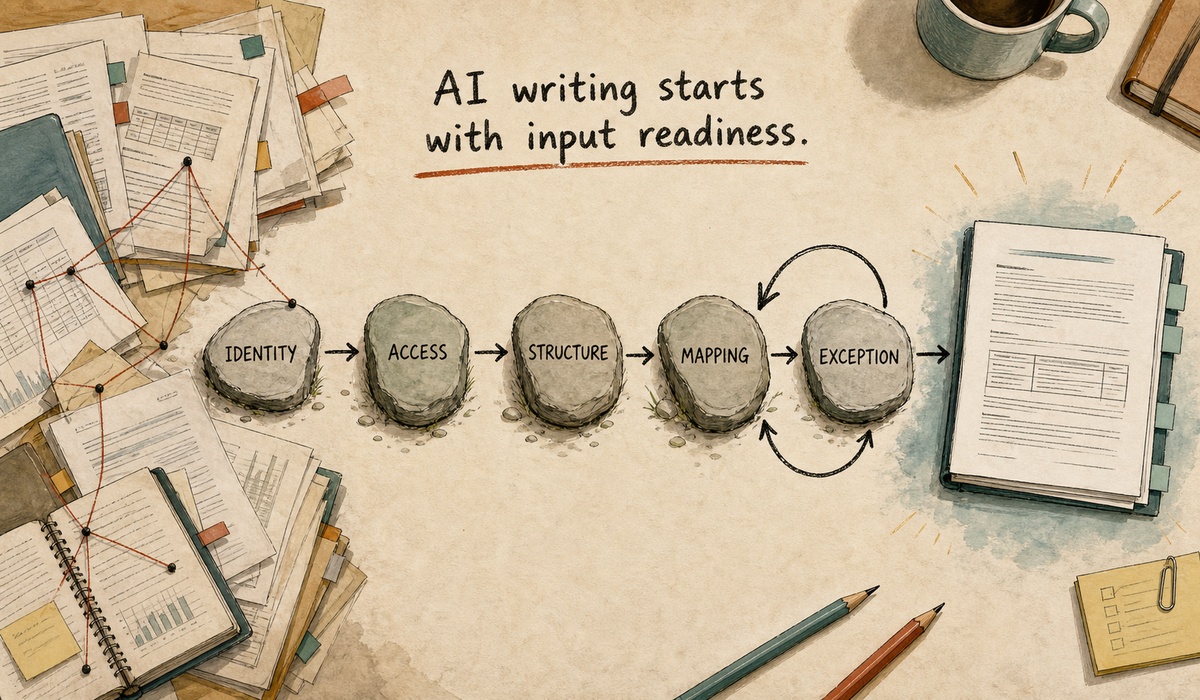
The first benchmark belongs upstream
An AI writing platform for life sciences should be evaluated on the fitness of its inputs before it is evaluated on the polish of its outputs. That means testing whether a team can identify the intended source, access the correct version, interpret its structure, map it to the right destination, and recover when the source does not behave as expected.
This article is for medical-writing leaders, clinical document teams, data and statistical programming partners, regulatory operations, and enterprise technology owners. It covers source readiness for AI-assisted authoring. It does not assess the scientific validity of a dataset, certify a source as submission-ready, or claim that software can replace the accountable human review of generated content.
The distinction is easy to miss because prose is what a demo puts on screen. Inputs are the quieter machinery behind it. Yet the U.S. Food and Drug Administration describes study data standards as a consistent framework for exchanging clinical and nonclinical research data between computer systems, including standard dataset structures, variable names, and calculation conventions. FDA also encourages sponsors to consider those standards early in the product-development lifecycle, not at the final handoff. See the FDA study data submission resources and the agency's Study Data Standards Resources.
Those resources govern study-data submission concerns, not AI writing software. Their upstream lesson still travels: format and provenance decisions made early determine how much ambiguity appears later.
Why clean demos hide input risk
Anonymized RFI and RFP patterns repeatedly connect ingestion readiness with integration, traceability, review, and delivery expectations. That cluster is a market signal. It is not evidence that AuroraPrime RMA, or any other platform, supports every requested format or workflow.
The standard pilot often uses a small set of tidy files selected by the vendor or project team. Headings are recognizable. Tables fit the parser. Filenames are sensible. Everyone knows which protocol belongs to which report because the pilot has only one study.
Routine work is less polite. A protocol and Statistical Analysis Plan may sit in different repositories. The newest file may not be the approved file. A table can contain split headers, nested variables, blank rows, or a caption that differs from its mapping entry by one stubborn character. One source arrives late. Another is present but not accessible to the writer. The failure does not look like a dramatic model hallucination; it looks like an empty section, a stale value, or a reviewer asking, “Where did this come from?”
That is why a pharma R&D document AI solution needs an input benchmark with failure cases. If the test includes only cooperative sources, it measures best-case generation. It says little about operational reliability.
The five-level Input Readiness Ladder
The Input Readiness Ladder turns “supports many data sources” into five observable questions. A source must climb each level; success at one level does not excuse failure at the next.
| Level | Readiness question | Evidence to capture | Typical failure |
|---|---|---|---|
| 1. Identity | Is this the intended source and version? | Owner, document type, date, status, and version | A newer draft is mistaken for the approved source |
| 2. Access | Can the intended user and workflow retrieve it? | Successful open, preview, or authorized retrieval | The file exists but the writer cannot reach it |
| 3. Structure | Can the relevant text or table be interpreted? | Parsed headings, captions, rows, columns, and units | Split headers or irregular tables change meaning |
| 4. Mapping | Is the source connected to the correct target section? | Source-to-section rule and a sampled trace | Correct content lands in the wrong narrative context |
| 5. Exception | Can the team see, route, and resolve a failure? | Error state, owner, correction, and retest | Missing data silently becomes missing prose |
The ladder is deliberately unforgiving. A file can be accessible and still be wrong. A table can parse and still be mapped to the wrong section. A correct mapping can break when the source layout changes.
Here is the contrarian view: input flexibility is not the number of file extensions on a slide. It is the number of representative sources a team can process with understood assumptions, visible exceptions, and a repeatable recovery path.
Level 1 and 2: identity before availability
Teams often collapse identity and access into a single checkbox: “The file uploaded.” Keep them separate. Identity asks whether this is the right artifact; access asks whether the right person and process can use it.
For a clinical study report, record at least five fields before generation: source document type, study identifier, version or status, effective date, and accountable owner. Then preview the source through the same path the writer will use. A successful upload by an administrator does not prove everyday access for an author.
Level 3 and 4: structure before mapping
Structure describes what the system can reliably recognize. Mapping describes where recognized content should go. The two fail differently and need different owners.
If a table header is misread, data or programming specialists may need to correct the input or parsing configuration. If the correct table is mapped to the wrong section, a template administrator or medical writer may need to revise the authoring rule. Calling both problems “AI quality” hides the route to a fix.
The International Council for Harmonisation E3 guideline describes the clinical study report as an integrated report in which clinical and statistical descriptions, presentations, and analyses are brought together. That integrated structure is exactly why a source-to-section decision carries meaning; content is not interchangeable simply because it can be extracted.
Level 5: exceptions are part of the product test
Do not wait for an accidental failure. Plant one. Remove a mapped file, alter a caption, provide a table with split headers, or withhold a late source until after the first draft. The pilot should reveal the condition without quietly inventing a substitute.
Then measure the response in four steps: detection, diagnosis, correction, and retest. If the team cannot name the owner of each step, the exception path is not operational yet.
This source-to-output view is consistent with the FDA's Electronic Source Data in Clinical Investigations guidance, which addresses reliability, quality, integrity, and traceability from electronic source data toward regulatory submission. The United Kingdom's MHRA GxP data integrity guidance adds a useful operational lens: understand data processes as a lifecycle, then apply risk-based controls and review. Neither document validates an AI-authoring product; both make a strong case for testing the route that information travels.
What AuroraPrime RMA documents about inputs
AuroraPrime RMA's clinical study report learning guide states that successful draft generation depends on selecting the correct related documents, such as the associated protocol and Statistical Analysis Plan, and that writers can preview those documents before generation. The initial-draft workflow separately documents upload and document-library selection paths for associated documents.
The same guide describes four section-generation methods: Copy (Source), Lean Summary (GenAI), Convert to Past Tense (GenAI), and Generate Synopsis Content (GenAI). It also describes two ways to point a rule at source content: an AI-assisted information-element search or an exact, case-insensitive section-name match. These options matter because source selection and transformation are explicit configuration decisions, not invisible assumptions.
For agentic generation in clinical summaries, the documentation describes a forward-slash assistant that lets a writer choose a specific folder, document, or document section. That is a concrete control for narrowing input scope. It does not prove the selected content is scientifically appropriate; it helps the user specify where the system should look.
The documentation is equally useful when things go wrong. A TFL sync can be marked unavailable when the expected file is missing from its designated location. A sync can also fail when no data are found or when source and in-document structures differ. For nested variables or split tables, writers can manually mark row and column headers when parsing misses them.
These are not promises that every source will ingest without intervention. Quite the opposite. They show why a credible test should include manual checkpoints and recoverable exceptions. For related perspectives, see from clinical data to regulatory narrative, TFL automation for clinical narrative accuracy, and multi-source draft generation with traceability.
Run an input-readiness test
Use a small but awkward evidence pack. Ten cooperative files teach less than five representative ones with known friction.
Step 1: choose five source conditions
Select one approved source document, one earlier version, one structured table file, one irregular table, and one intentionally missing or late source. Remove client or personal data if the environment is not approved for it.
Step 2: write the source manifest
For each source, record the five identity fields: type, study, version or status, date, and owner. Add the intended target section and the permitted transformation, such as copy, summary, tense conversion, or evidence-only reference.
Step 3: test with two personas
Run the same path as an administrator and as a writer. The administrator's success can conceal a permission or repository problem that the everyday user will encounter.
Step 4: sample three mappings
Trace one prose section, one table, and one cross-document fact. For each, capture the selected source, extraction or match rule, destination, and reviewer decision. Three deep traces are more revealing than a screenshot of fifty green check marks.
Step 5: force two failures
Trigger a missing-source condition and a structural mismatch. Confirm that the workflow exposes both, gives the user enough context to diagnose them, and supports a correction followed by a clean retest.
Step 6: define the pass rule
A practical pass rule might require all five sources to have confirmed identity, all intended users to retrieve permitted material, all three sampled mappings to be correct, and both planted failures to be detected and resolved. Set thresholds for the actual risk profile; do not borrow attractive numbers from a vendor slide.
The resulting evidence pack is modest: a source manifest, three trace samples, two exception records, and one signed decision. That is enough to show whether inputs are governed or merely available.
Frequently asked questions
What is input readiness for AI regulatory authoring?
Input readiness means a source can be identified, accessed, structurally interpreted, mapped to the intended document context, and handled when an exception occurs. It is broader than file-format compatibility and narrower than a claim that the underlying science is valid.
Should an AI writing pilot use clean or messy data?
Use both. Clean sources establish the intended path; representative messy sources reveal operational limits. Include at least one missing source and one structural mismatch so the team can test detection, ownership, correction, and retesting.
Does AuroraPrime RMA support source selection controls?
Local documentation describes related-document selection and preview, document-library reuse, section-level source rules, AI-assisted or exact section selection, a folder/document/section input assistant, TFL sync statuses, and manual table-header marking.
Does successful ingestion prove the generated content is accurate?
No. Successful ingestion shows that a source entered the workflow and could be interpreted under tested conditions. Scientific accuracy still depends on correct source choice, mapping, transformation, and accountable human review of the output.
How many source files should a pilot test?
There is no universal number. Start with a small representative set that covers different source types, versions, permissions, structures, and failure modes. Five well-chosen conditions can reveal more than a large folder of nearly identical clean documents.
Conclusion
An AI writing platform for life sciences starts earning trust before it writes a sentence. The decisive questions are upstream: Is this the right source? Can the writer reach it? Does its structure survive interpretation? Is it mapped to the right context? What happens when it breaks?
AuroraPrime RMA documentation describes concrete controls and failure states that can be exercised in that test, including associated-document preview, four generation methods, two source-selection approaches, section-level input selection, TFL sync statuses, and manual header correction. Those features support an input-readiness process; they do not replace the team's scientific and procedural decisions.
To discuss an input-readiness evaluation for AuroraPrime RMA, contact AlphaLife Sciences.
