




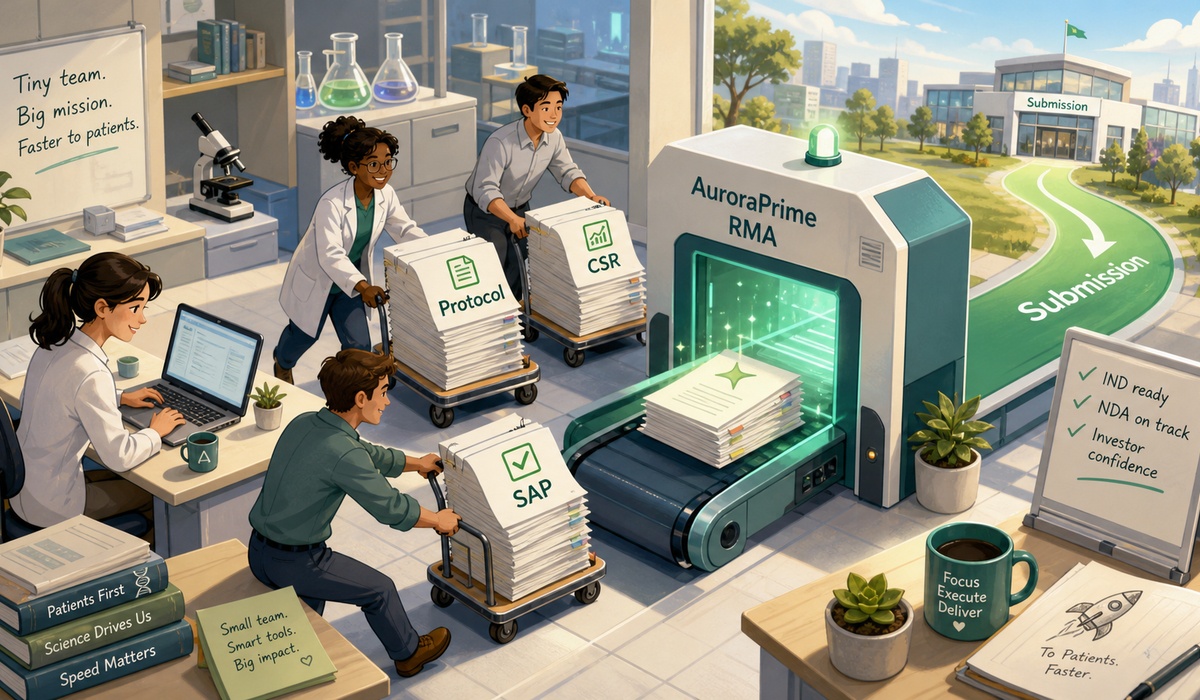
The Biotech Capacity Problem
Biotech teams often run enterprise-grade science with startup-sized writing operations. A single team may need to prepare a protocol, support a clinical study report, respond to reviewer input, assemble patient narratives, and keep the next financing milestone in sight. Hiring more writers is not always possible, and outsourcing every bottleneck can make timelines feel less controllable.
This article is for emerging biotech executives, clinical operations leaders, regulatory affairs teams, and medical writing owners looking for an ai writing solution for pharmaceutical companies that can increase throughput without sacrificing control. It focuses on writing capacity, not full resourcing strategy or vendor selection.
AuroraPrime RMA helps because it is built around regulated document work rather than generic content generation. The add-in is tailored for clinical documents such as clinical study reports and study protocols. It operates inside Microsoft Word 365, where writers can use the add-in without switching between applications.
Where AuroraPrime RMA Adds Leverage
Small teams need leverage in the places where writing time disappears. AuroraPrime RMA supports initial draft generation from AI-powered templates, section-level regeneration, related source documents, AI task tracking, and document insertion workflows.
For protocol drafting, users select related documents from the Document Library, such as a study design concept sheet or protocol synopsis, to serve as references. The system generates content section by section and inserts it into corresponding template locations. When the draft is generated, users can view the associated AI tasks and navigate directly to a corresponding document section.
This matters for biotech teams because the first draft is rarely the final problem. The real problem is moving from draft to defensible draft. AuroraPrime RMA lets writers regenerate specific sections by reviewing generation rules, adding prompts, and providing additional reference documents.
Capacity Gains Without Blind Automation
| Biotech Pain Point | AuroraPrime RMA Capability |
|---|---|
| Few writers supporting many deliverables | AI-powered templates and section-level generation |
| Protocol content needs source context | Related documents from the Document Library |
| Draft sections need refinement | Rule review, additional prompts, and regeneration |
| AI output needs review | AI task details and section navigation |
| Writer cannot wait for every background task | Asynchronous AI tasks for work such as translation, polishing, tense conversion, and lean summary |
The promise is not "remove the writer." The promise is "give the writer more reachable surface area."
Patient Narratives Show the Bandwidth Story Clearly
Patient narratives are a useful stress test for biotech capacity. They are essential to clinical study reports, but they can become painfully repetitive, data-heavy, and deadline-sensitive.
AuroraPrime Patient Narratives is described as an AI-powered SaaS solution for streamlining the creation of patient narratives, an essential component of CSRs. The product documentation reports a 95% reduction in time required for drafting initial narratives and up to 70% acceleration in the overall narrative generation process.
The same product documentation describes versatile data import across EDC data, SDTM, ADaM, medical coding, SAE data, and CIOMS. It also supports flexible data configuration, including mapping data from CRFs to narrative fields, merging multiple sources, and post-processing through AI-generated conversion scripts.
For a small biotech, this is not just a feature list. It is the difference between narrative work becoming a submission bottleneck and narrative work becoming a managed production process.
Small Teams Still Need Governance
Lean teams do not get an exemption from quality. If anything, they need governance even more because the same people are often writing, reviewing, coordinating, and defending decisions.
AuroraPrime RMA supports AI task workflows where users can view detailed results, continue with AI Chat, insert output into the document, or manually remove a task. AI tasks such as translation, polishing, tense conversion, and lean summary can run asynchronously while the writer continues other work.
The product also supports feedback on AI-generated content. Users are encouraged to provide feedback after tasks such as auto-generating TFL summaries, polishing text, or translating. Negative feedback can be categorized as false content, irrelevant content, unprofessional statements, or other issues.
That feedback loop matters for small teams because every bad output costs time. A system that helps classify failure modes can support better reuse and refinement over time.
Biotech Readiness Checklist
Before adopting an ai powered medical writing solution, biotech teams should ask:
Which document type is the first bottleneck? Protocol, CSR, patient narratives, SAP, or lay summary?
Which source documents are reliable enough for AI grounding? Concept sheets, synopses, datasets, or prior drafts?
Which sections need generation versus reuse? Do not automate every paragraph the same way.
Who approves AI-generated text? Define writer and reviewer ownership early.
What is the minimum traceability requirement? Decide what evidence reviewers need to trust an output.
Which feedback categories matter? False content and irrelevant content should be treated differently.
What should stay human-only? Clinical judgment, final interpretation, and regulatory positioning still need accountable experts.
The right rollout starts with one bottleneck and one measurable improvement. For many emerging teams, that is enough to change the week.
Frequently Asked Questions
How can AI help small biotech medical writing teams?
AI can help small biotech teams create initial drafts, regenerate difficult sections, summarize data, and manage repetitive writing tasks. The key is to keep AI outputs tied to source documents, templates, review controls, and human approval.
Is AuroraPrime RMA only for large pharma?
No. AuroraPrime RMA supports regulated authoring workflows that are useful for both large enterprises and lean biotech teams. Smaller teams may benefit from faster drafting, source-grounded regeneration, and reduced repetitive workload.
Can AuroraPrime RMA support patient narrative work?
Yes. AuroraPrime Patient Narratives supports AI-powered narrative creation for CSRs and can import data types such as EDC, SDTM, ADaM, medical coding, SAE data, and CIOMS.
Does AI replace biotech medical writers?
No. In regulated authoring, AI should expand writer capacity, not remove accountability. Writers still need to review source fit, clinical meaning, regulatory language, and final document quality.
What is the safest first use case for biotech teams?
A good first use case is a repeated, source-heavy writing task with clear templates and measurable time pressure, such as protocol drafting support, patient narratives, or selected CSR sections.
Conclusion
Biotech teams do not need more AI theater. They need capacity. AuroraPrime RMA helps small teams turn source materials, templates, rules, and AI tasks into a more manageable writing operation.
By supporting template-based generation, section regeneration, narrative automation, asynchronous tasks, and feedback-driven improvement, AuroraPrime RMA gives lean teams a practical way to write more without lowering the bar.
To explore AuroraPrime RMA for biotech medical and regulatory writing, contact AlphaLife Sciences at https://alphalifesci.com/contact-us.
