




Continuous Vigilance: Streamlining PV Periodic Reports PSUR DSUR with AI
Apr 15, 2026Enhance your aggregate safety reporting with AuroraPrime RMA. Learn how AI automates the heavy lifting of PSUR and DSUR authoring while maintaining strict compliance.
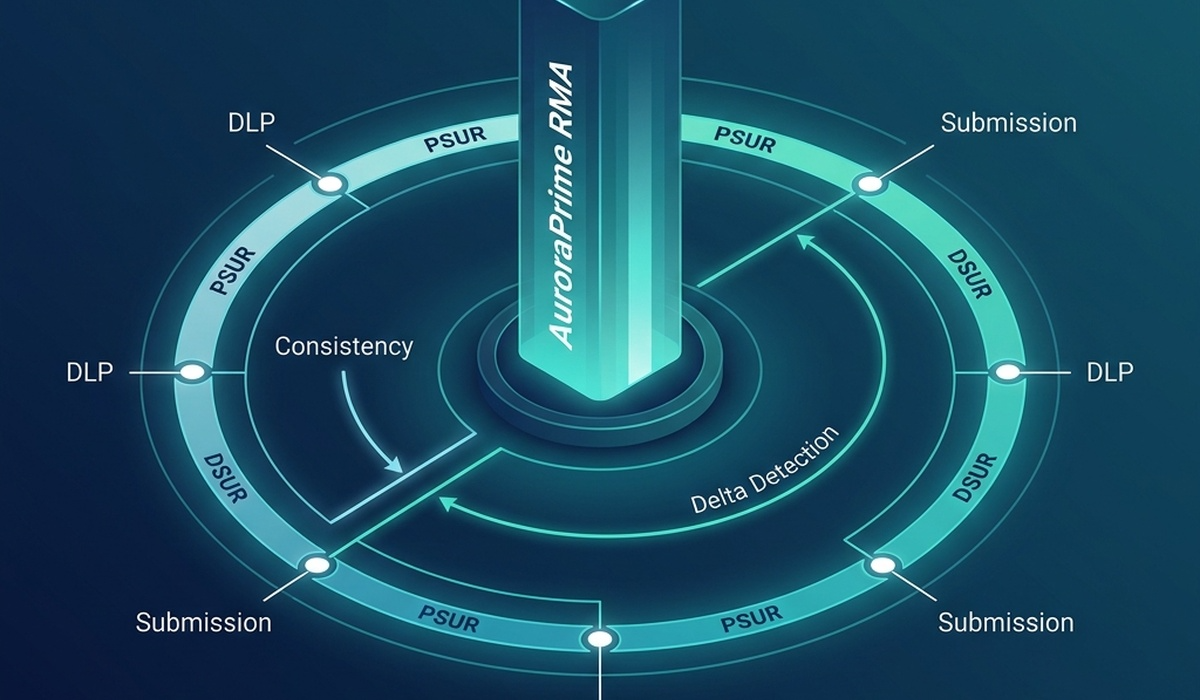
Pharmacovigilance is defined by its data cycles, and the most demanding of these is the periodic report. Whether it’s a Development Safety Update Report (DSUR) during clinical trials or a Periodic Safety Update Report (PSUR) after a drug hits the market, these documents are how you prove a drug still carries a favorable benefit-risk profile.
But for most PV teams, "periodic" usually means "prepared in a panic." You’re often chasing data across legacy systems, manually checking for consistency with reports from two years ago, and trying to pull a clear narrative out of thousands of individual case safety reports (ICSRs).
At AlphaLife Sciences, we've seen how this manual slog leads to burnout and, worse, clerical errors. By using AuroraPrime RMA, we’re helping teams automate the mechanical parts of Pharmacovigilance Automation, so they can spend their time on actual signal analysis.
The aggregate reporting hurdle
Writing periodic reports is different from other regulatory tasks because it's inherently longitudinal. You're never just looking at the now; you're looking at the then, too.
1. The longitudinal trap
A PSUR or DSUR has to be cumulative. Ensuring that this year's data doesn't contradict the Reference Safety Information (RSI) or previous period reports is a massive time sink. One slightly different number can trigger a whole chain of regulatory queries.
2. Narrative volume
Periodic reports aren't just data tables. They require deep analysis of signals and risk evaluations. Manually drafting these sections for an entire portfolio is a resource drain that most companies can no longer afford.
3. The DLP crunch
The clock starts ticking the second you hit the Data Lock Point (DLP). Regulatory agencies don't give you much lead time, and any friction in your drafting process puts your compliance status at risk.
How AuroraPrime RMA changes the workflow
RMA is a specialized environment for DSUR and PSUR AI authoring. It’s built to handle the iterative nature of safety docs.
Automated comparison with the "Last Period"
RMA can link your current draft to its predecessors. Using AI Extraction, the system handles two big tasks:
Spotting changes: It automatically flags what’s changed in the safety profile since the last report.
Cumulative consistency: It carries over baseline data and history sections accurately, so you aren't re-typing the same information year after year.
Drafting with Lean Summaries
RMA’s Lean Summary method is great for the descriptive sections of a DSUR—like summarizing trial progress or signal evaluations. Instead of writers spending a day summarizing a trial’s status, the AI reads your clinical trial management system data and drafts a concise update in seconds.
Signal evaluation support
If a writer needs to explore a new safety signal, they can use the AI Chat feature. Asking the system to "summarize new safety events from the last six months related to [X event]" gives the writer an immediate, evidence-backed starting point for their analysis.
Compliance and trust
We know "AI" can make safety teams nervous. That's why AuroraPrime RMA is built with specific safety rails:
Full traceability: Every claim in your PSUR or DSUR links back to its source. Whether it’s a previous report or a safety database export, you can always prove where a number came from.
Veeva Vault integration: RMA pulls directly from Veeva Vault Safety and RIM. You’re always working with the most current, approved versions of your metadata.
Automated QC: The system checks that your Executive Summary matches the data in your tables. It catches the small typos that humans miss when they're working against a deadline.
FAQ
Can AI replace a medical reviewer?
No. RMA automates the drafting and data gathering. The final scientific judgment, especially the benefit-risk call, is still a human responsibility. The point is to give the expert a better starting point.
Does it follow ICH E2C/E2F?
Yes. RMA uses AI-enabled templates pre-configured for ICH standards. Your reports will have the right headings and all the mandatory sections from day one.
Is the data secure?
Yes. RMA runs in a secure, private cloud. Your data isn't used to train any public AI models, so you stay compliant with GDPR and HIPAA.
Conclusion
Periodic reporting shouldn't be a crisis. By using an AI Writing Solution for Life Sciences, your team can stop being document assemblers and start being safety strategists.
AuroraPrime RMA doesn't just write; it provides a platform for continuous, automated vigilance.
**See how we’re streamlining safety: https://alphalifesci.com/contact-us
