




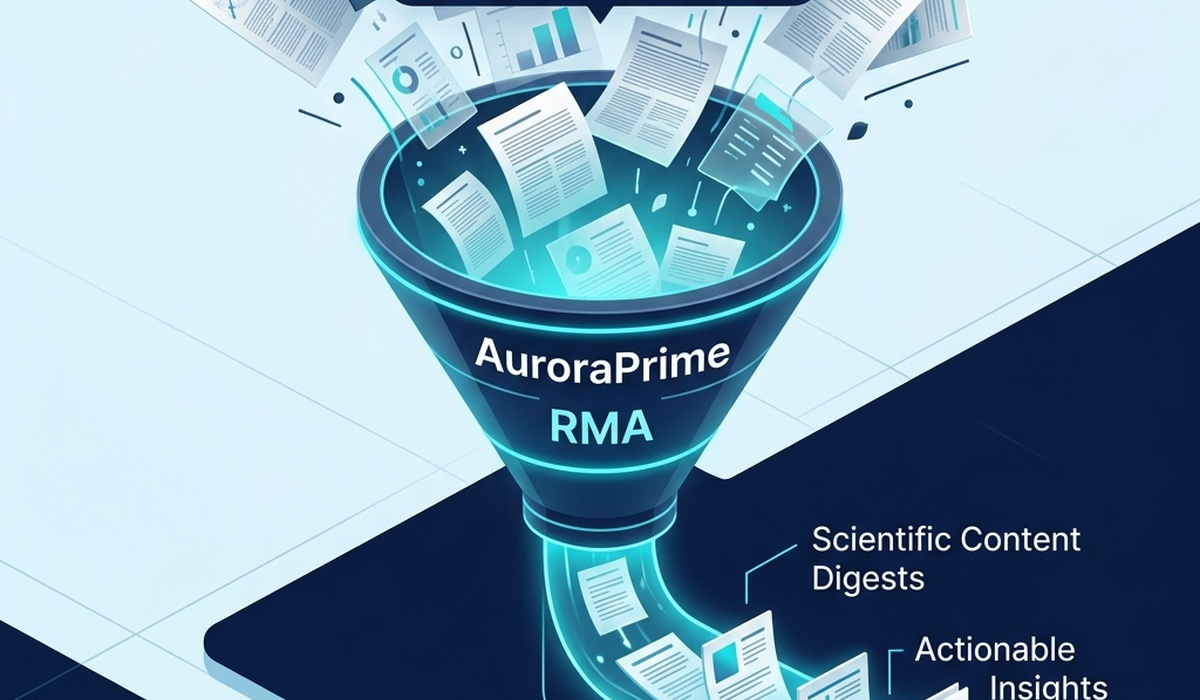
The volume of scientific output is out of control. In the life sciences, the rate of publication is such that even a dedicated specialist can't keep up with every new study in their therapeutic area. For Medical Affairs teams, this constant stream of information makes it harder to maintain a clear technical lead in the field.
Traditionally, creating a Scientific Content Digest—a concise look at recent, relevant publications—is a slow, manual process. It requires a deep grasp of clinical methodology and a massive time commitment to read, analyze, and synthesize multiple papers into one coherent report.
At AlphaLife Sciences, we're changing that. By using AuroraPrime RMA, Medical Affairs teams are using Medical Communications Automation to turn a pile of raw PDFs into strategic intelligence in minutes.
The exhaustion of information overload
Medical Affairs professionals face a few specific hurdles when managing scientific content:
1. The publication lag
By the time a manual literature review is finished and sent to the MSLs, new data has usually already come out. Staying "current" is impossible when you're drafting everything by hand.
2. Synthesis fatigue
Synthesis is the hard part. Pulling results from five different studies to find a single clinical trend is mentally exhausting. It’s also where human errors—like missing a specific P-value or confusing two patient cohorts—usually happen.
3. One size doesn't fit all
A field MSL needs a deep-dive technical summary, but the commerical team just needs a high-level "executive digest." Manually reworking the same data for different stakeholders is a huge duplication of effort.
Streamlining insights with AuroraPrime RMA
AuroraPrime RMA is a specialized environment for Literature Summarization. It's built to handle biopharma's complex science, not just generic text.
Multi-doc synthesis with Lean Summaries
RMA’s Lean Summary method lets you ingest multiple sources at once—full papers, abstracts, or conference posters.
Spotting trends: You can ask the AI to "identify the consensus on Drug X’s efficacy in Population Y across these four papers."
Rapid drafting: You get a structured digest that highlights the most important findings, with citations for every single claim.
AI Extraction for the hard data
RMA doesn't just summarize text; it handles the numbers too. With AI Extraction, you can ask the system to "build a comparison table of sample sizes and P-values for all studies in this folder." This turns a qualitative summary into a quantitative tool for the field.
Research support on the go
For teams in the field, the AI Chat feature acts like a research assistant. If an MSL gets a specific question about a trial’s exclusion criteria at a conference, they can use RMA to find and summarize that specific section in seconds.
Accuracy first
In Medical Affairs, being "mostly right" is the same as being wrong. AuroraPrime RMA ensures scientific integrity through:
Strict grounding: The AI only uses the documents you provide. It doesn't pull "facts" from the open web, which prevents hallucinations.
Traceable citations: Every bullet point in a digest links back to a specific page in the source PDF. Medical reviewers love this because it makes their job ten times faster.
One source of truth: By using a single "Information Base," you ensure that the technical MSL digest and the marketing summary reflect the exact same data points.
FAQ
Can AI replace the need to read full papers?
No. AI is a tool for prioritizing. It helps experts decide which papers need a deep read and gives them a baseline for everything else. The final call on "clinical significance" still belongs to the expert.
Does it work with internal databases?
Yes. RMA can ingest content from various repositories, so it fits right into your existing KM and medical comms workflows.
How does it handle global literature?
RMA can translate and summarize across dozens of languages. You won't miss a key insight just because it was published in a regional journal.
Conclusion
The goal of Medical Affairs is to be the scientific voice of the organization. But that voice gets drowned out if you're spending all your time just trying to stay afloat in the data. GenAI for Medical Affairs isn't just about speed; it's about clarity.
Stop drowning in data and start driving the conversation.
Transform your scientific communications: https://alphalifesci.com/contact-us
