




Kickstarting 2026 with Clarity and Control: What’s New in AuroraPrime RMA
Jan 27, 2026🚀 A new year brings new complexity—and new opportunity—in regulatory, medical, and clinical work. As 2026 kicks off, teams are being asked to move faster, stay inspection-ready, and maintain absolute control over increasingly interconnected content and data.At AlphaLife Sciences, we’re pushing the boundaries of what AI can do in real-world regulatory and clinical operations. The latest AuroraPrime RMA updates are designed to give professionals more clarity, more confidence, and more control—turning AI from a black box into a true partner in decision-making 🧠⚙️. From smarter content generation to tighter traceability and governance, this release reflects what modern life sciences teams actually need to deliver impact at scale.If you’re working at the intersection of regulation, medicine, and clinical science—and thinking seriously about how AI can elevate both quality and speed—this one’s for you 🌍📊.
If there is one resolution we all share in life sciences, it is to leave the chaos of manual document management in the past. At AlphaLife Sciences, we believe that an AI platform shouldn’t just write for you—it should help you think, organize, and collaborate more effectively.
That is the philosophy behind our latest January 2026 release of AuroraPrime RMA. While our GenAI continues to get smarter at drafting complex narratives, this update focuses on the infrastructure that surrounds your writing: better organization, tighter quality control, and smoother collaboration for your team.
Here is a look at how the new features in AuroraPrime are designed to streamline your regulatory and medical authoring workflow this year.
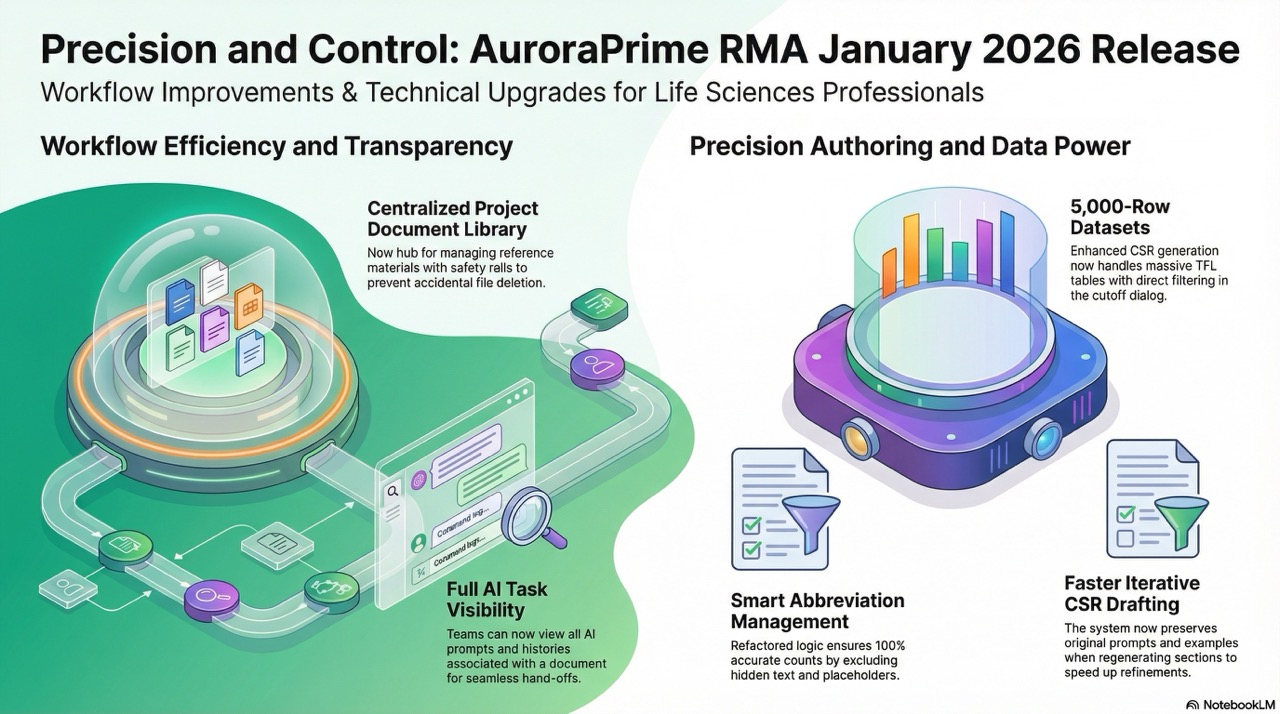
A New Hub for Your Project Documents
We know that writing a Clinical Study Report (CSR) or a Protocol never happens in a vacuum. You are constantly referencing SAPs, Investigator Brochures, and cross-project materials. With the new Document Library, you can now manage these files directly at the project level.
This centralized approach means you no longer have to hunt through disconnected folders. Documents are intuitively organized into clear categories like "Associated" (for reference materials), "Interim" (for temporary results), and "Shared" materials. Plus, we have added safety rails: if you try to delete a document version that is currently in use, the system will warn you immediately, preventing the accidental loss of critical references.
The "QC Headache" Cure: Smarter Abbreviation Management
Managing abbreviation tables is often one of the most tedious parts of finalizing a submission. In this release, we have completely refactored the Abbreviation Table Management feature to give you precision control and save hours of manual checking.
Accuracy You Can Trust: The system now excludes hidden text and placeholders inside Content Controls when calculating occurrences, ensuring your counts are 100% accurate.
Flexible Formatting: Whether you are using a standard format or the specific "Term | Definition" style required by some protocols, the system adapts automatically.
Granular Control: You can now specify exactly which sections to include in the calculation and use row-level checkboxes to decide which abbreviations make the final cut.
Collaboration with Full Transparency
Writing is a team sport, and using AI should be too. Previously, you could easily lose track of what prompts your co-authors had already run. Now, you can view all AI tasks associated with a document, regardless of who initiated them.
By toggling the view from "Only Mine" to the complete history, you gain full visibility into the document’s evolution. This is invaluable for troubleshooting and ensures that hand-offs between writers are seamless.
Faster Iterations and "Big Data" Support for CSRs
When you are refining a TFL (Tables, Figures, and Listings) summary, you often need to tweak the output without starting from scratch. Our enhanced CSR generation now preserves your original settings—including examples and additional prompts—when you hit regenerate. This allows you to iterate faster without re-typing your instructions.
Additionally, for those working with massive datasets, the TFL Summary generation now supports tables with up to 5,000 rows. You can filter these large datasets directly in the cutoff dialog, ensuring that even the most complex studies are summarized accurately.
Ready to Upgrade Your Workflow?
This release is about giving you the confidence that your tools are as precise as your science. From the transparency of seeing generation rules right next to section headings to the robustness of the new document library, AuroraPrime is ready to handle your most demanding 2026 timelines.
These features are live now. We invite you to log in, explore the new Document Library, and experience a smoother path to final approval.
