




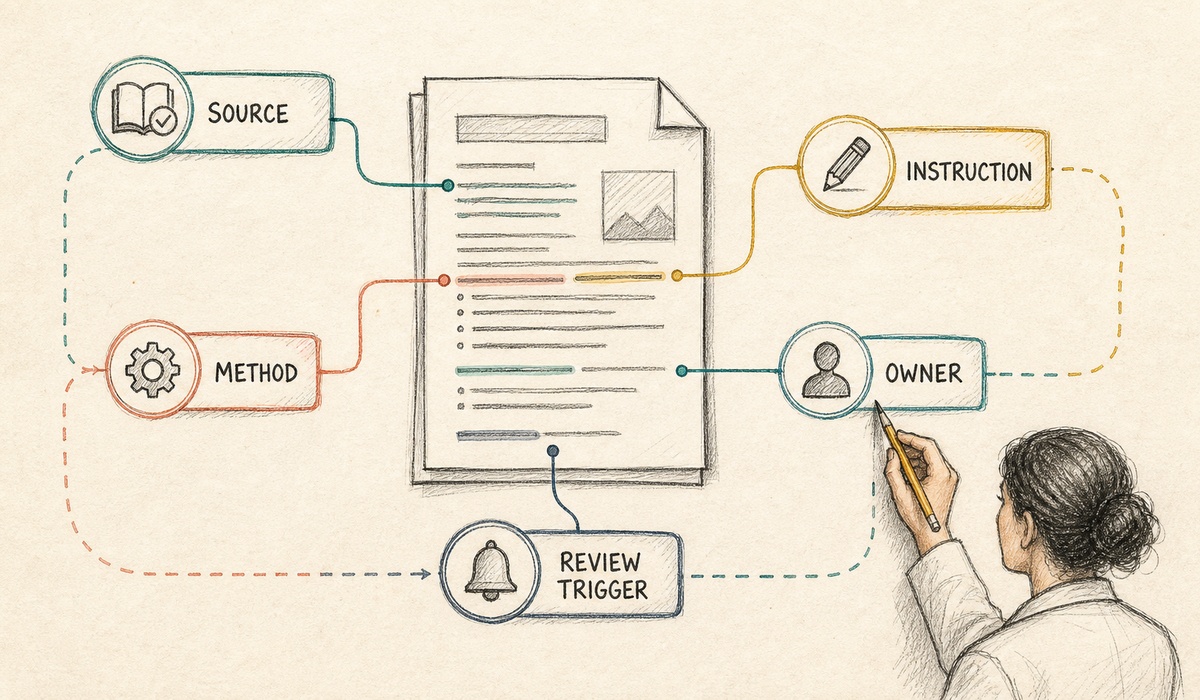
The real template risk is invisible logic
A pharma AI writing platform needs visible generation rules because a medically plausible paragraph can still be wrong for its section, source, or intended use. Writers and reviewers should be able to answer a simple question without calling the template administrator: What instruction produced this content? If the answer is buried, the organization has created rule debt.
This article is for regulatory and medical writing leaders, template administrators, quality partners, and platform owners. It covers the operational visibility of document-generation rules. It does not prescribe computer-system validation, claim that visible rules guarantee a correct draft, or suggest that a software configuration is accepted by a health authority.
The market signal is clear even when confidential procurement language is stripped away. Life-sciences teams repeatedly ask for governed templates, defined sources, reusable instructions, human review, and evidence that explains how content was produced. Those patterns describe an operating need. They do not establish what any vendor supports; that has to come from product documentation.
Rule visibility matters because a template is no longer just a collection of headings and styles. In an AI-enabled workflow, it can also carry decisions about how a section is created, which information it should use, and what additional instruction shapes the result. Our article on low-code AI templates for regulatory authoring explains why reusable configuration belongs inside the operating model, while AI authoring inside the document workflow examines the writer's point of work. The International Council for Harmonisation E3 guideline describes a clinical study report as an integrated report that brings clinical and statistical description, presentations, and analyses together. That integration makes the logic connecting source material to section content worth exposing, not hiding.
What rule visibility means in practice
Visible does not mean flooding every writer with configuration screens. It means surfacing enough context for the person doing the work to recognize whether the rule fits the section in front of them.
Consider a writer reviewing an inclusion-criteria section. The prose reads smoothly, but the writer notices that a protocol amendment changed the population definition. Five questions follow immediately:
Which source document and section were selected?
Was the content copied, transformed, summarized, or generated?
Did an additional prompt narrow or expand the task?
Who owns the reusable rule?
What event requires the section to be checked again?
That is the difference between content review and content forensics. Review asks whether the output is suitable. Forensics first has to reconstruct the process that created it. A mature enterprise AI content platform for pharma should minimize that reconstruction burden.
The U.S. Food and Drug Administration and European Medicines Agency's 10 Guiding Principles of Good AI Practice in Drug Development include clear context of use, data governance and documentation, human-centric design, and lifecycle management. The principles are broad and do not define medical-writing template requirements. Still, they support a practical conclusion: people cannot exercise meaningful oversight over logic they cannot see.
Hidden rules create three kinds of debt
First comes review debt. Reviewers spend time reverse-engineering the drafting logic instead of judging the scientific argument. Second comes change debt. When a source, standard, or writing convention changes, teams struggle to identify which reusable instructions deserve attention. Third comes training debt. New writers learn folklore from experienced colleagues because the rule itself does not explain its purpose.
None of these debts appears in a polished demonstration. They surface later, often during a handoff, a template revision, or the first difficult exception. That is why rule visibility should be tested with an unfamiliar writer, not only with the person who configured the template.
Use the five-field Rule Visibility Card
The Rule Visibility Card is a compact operating artifact for every AI-enabled section. It is not a regulatory record by itself. It is a practical way to make the drafting contract inspectable.
| Field | Question it answers | Example of useful detail | Review signal |
|---|---|---|---|
| 1. Source | What evidence is the section allowed to use? | Related study document plus named section or information element | Source added, replaced, or updated |
| 2. Method | What operation is performed? | Copy, transform tense, lean summary, or synopsis generation | Method changes or no longer fits the section |
| 3. Instruction | What additional direction shapes the output? | Audience, emphasis, exclusions, or formatting constraint | Prompt wording changes |
| 4. Owner | Who can explain and maintain the reusable rule? | Named template role or governance group | Ownership or role changes |
| 5. Review trigger | When must a human reconsider the rule? | New source version, template release, exception, or periodic review | Trigger occurs |
The card avoids a common trap: showing only the prompt. A prompt without its source and method is like an ingredient list without quantities. It reveals vocabulary but not the recipe.
Score visibility at the point of work
Use a simple four-level check during a pilot or template review:
Absent: The writer sees output but no rule context.
Recoverable: An administrator can retrieve the configuration after the fact.
Visible: The writer can inspect the relevant rule while reviewing the section.
Actionable: The writer can identify the owner and initiate the correct change or exception path.
Do not average these levels across an entire document. A section with high scientific risk may need actionable visibility even if a routine formatting section only needs recoverable configuration. The allocation should follow intended use and risk, not symmetry.
What AuroraPrime RMA documents
AuroraPrime RMA documentation describes section-level content-generation rules with a generation method, an information source, and optional additional prompts. The documented methods include Lean (AIGC), Convert to Past Tense (GenAI), Copy (Source), and Generate Synopsis Content (GenAI), with method-specific constraints. These are configuration options, not proof that any generated section is correct.
The documentation also describes a way to view section-generation rules from an icon next to the section heading. It explicitly says the feature is currently enabled for a number of document types, including study protocol and DSUR. That scope qualifier matters. A responsible product description should not silently generalize a documented feature to every document type.
Finally, configured templates must be published to the AuroraPrime RMA Content Library before medical writers in the organization can use them. Publication creates a useful governance moment: the team can decide what must be checked before a reusable rule reaches writers.
| Question | Visible-rule workflow | |
|---|---|---|
| Why did this paragraph appear? | Ask the configurator or infer from output | Inspect method, source, and instruction |
| What changed? | Compare drafts and guess at configuration | Review the changed rule field and affected sections |
| Who owns the fix? | Route through informal contacts | Use the accountable owner on the rule card |
| Can a writer challenge the logic? | Only after reconstructing it | Raise an exception with context attached |
| Is visibility universal? | Often assumed | Document scope and limitations by document type |
This is the product-reference hook for buyers: test what the intended user can actually inspect. Do not settle for a slide that says "traceable" or "configurable." Ask the demonstrator to open a section, show the rule, identify its source, state the feature's document-type scope, and explain how a change reaches the rule owner. For the wider governance question, see enterprise AI regulatory writing without losing control.
Build visibility into four operating moments
Rule visibility works when it appears at the moments people already make decisions. Adding a large governance meeting after every template change will create ceremony, not clarity.
1. Template design
Require the five card fields before a rule can be considered ready. The owner should explain why a method and source fit the section, including at least one condition where the rule should not be used. This turns configuration into an explicit design decision.
2. Template publication
Use publication as a release gate. Check that the rule has an owner, that visible labels match the configuration, and that scope limitations are written in plain language. If a quick-view feature applies only to certain document types, record that boundary instead of relying on oral knowledge.
3. Section review
Place rule context close to the section. The writer should be able to compare output with source and instruction without leaving the authoring flow for a separate investigation. The goal is not to make every reviewer a template engineer. It is to let a reviewer recognize when the drafting contract does not fit the work.
4. Change and exception handling
When a source, method, prompt, or owner changes, update the card and decide which sections need renewed review. When a reviewer rejects output, capture whether the problem came from the source, the method, the instruction, or the output itself. Those categories make the next decision sharper.
The National Institute of Standards and Technology AI Risk Management Framework Core separates govern, map, measure, and manage activities and calls for defined human-AI roles and documented oversight. It is voluntary and cross-sector. For writing operations, its useful lesson is that oversight needs both information and responsibility: someone must see the rule, and someone must own what happens next.
A seven-question buyer test
Use this short test in a demonstration or controlled pilot:
Can a writer identify the source selected for a section?
Can the writer distinguish copying from AI-assisted transformation or generation?
Can the writer view additional instructions that materially shape the output?
Can the team state which document types support point-of-work rule viewing?
Can an administrator identify the published template and accountable owner?
Can a reviewer route a rule problem separately from an output-editing problem?
Can the organization show what happens when the rule changes after work has begun?
A "no" is not automatically a product failure. It is a design gap to classify, own, and test. That distinction keeps the evaluation honest.
Frequently asked questions
What is rule visibility in a pharma AI writing platform?
Rule visibility is the ability for an intended user to inspect the source, generation method, additional instruction, owner, and review trigger associated with an AI-enabled document section. It supports informed review, but it does not by itself validate the system or guarantee accurate content.
Should every medical writer be allowed to edit generation rules?
No. Visibility and edit authority are separate controls. A writer may need to inspect a rule and raise an exception while only a designated template role can change and publish the reusable configuration. Organizations should define those permissions according to intended use and governance.
Is showing the prompt enough for traceability?
Usually not. A prompt does not identify the permitted source, the generation method, the rule owner, or the event that requires renewed review. A useful explanation connects all five fields to the section and preserves the product's documented scope limits.
How should teams test visible rules during a pilot?
Give an unfamiliar writer a section with one deliberately unsuitable source or instruction. Ask the writer to detect the mismatch, identify the rule owner, and route the issue without help from the configurator. Record the evidence and repeat the test after a rule change.
Conclusion
A pharma AI writing platform needs visible rules because oversight begins before a reviewer edits the first sentence. The real object of governance is the drafting contract: what source can be used, what method acts on it, what instruction shapes it, who owns it, and when it must be reconsidered.
Start small. Select one high-consequence section, create its five-field Rule Visibility Card, and let an unfamiliar writer test whether the logic is understandable at the point of work. Then decide which visibility level the section actually needs.
To explore how AuroraPrime RMA supports governed regulatory and medical authoring workflows, contact AlphaLife Sciences.
