




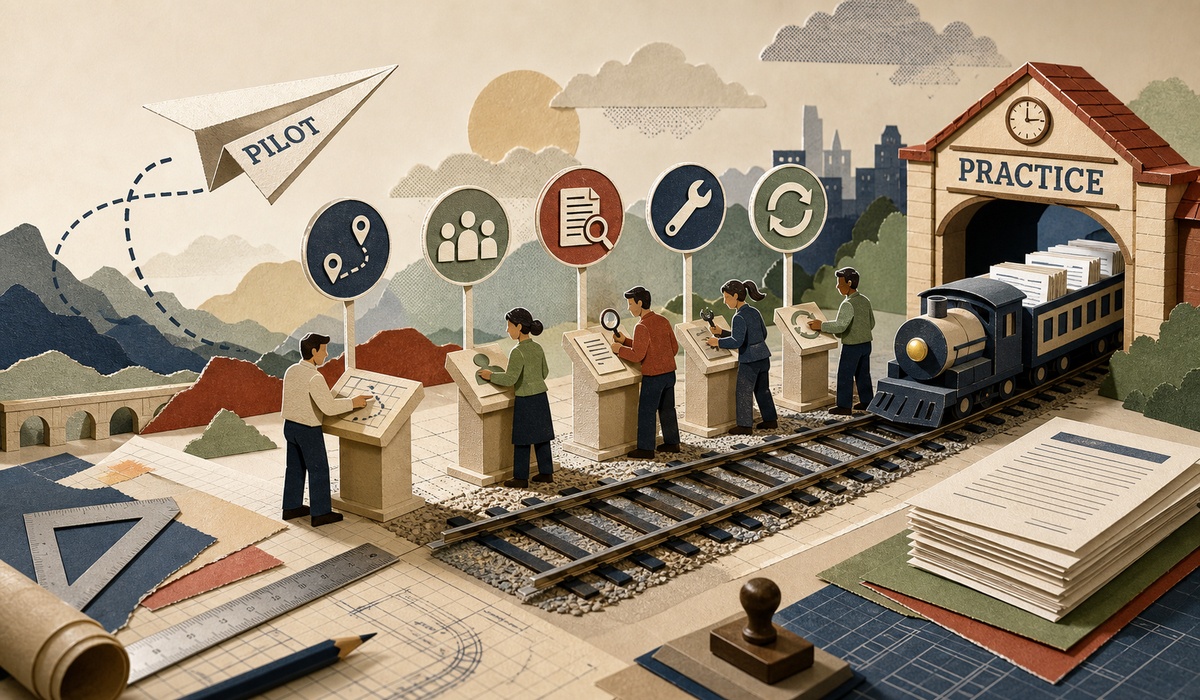
A pilot is a temporary operating system
A pharma AI writing platform pilot needs written exit criteria that define what evidence allows the organization to proceed, revise, limit, or stop. Useful criteria go beyond output quality. They cover whether the workflow is representative, roles are workable, review evidence is usable, exceptions have owners, and results can repeat without the people who designed the pilot standing nearby.
This article is for medical-writing leaders, regulatory and clinical operations, quality and validation partners, enterprise AI owners, change leaders, and platform administrators. It covers the operational decision to move from a bounded pilot toward routine use. It does not prescribe validation, claim regulatory acceptance, or suggest that one score can replace an organization's risk-based intended-use assessment.
The NIST AI Risk Management Framework treats AI risk management as a lifecycle activity rather than a one-time review. Its AI RMF Core calls for defined human roles, training, documentation, and ongoing decisions about whether development or deployment should proceed. NIST's framework is voluntary and cross-sector. It is useful here because a pilot-to-practice decision is exactly that: a documented judgment about whether, where, and under whose responsibility use should proceed.
Exit criteria prevent a pilot from quietly becoming production by calendar drift.
Why impressive drafts do not prove adoption
Anonymized RFI and RFP patterns often connect adoption and delivery expectations with workflow, review, traceability, scalability, and service. This pattern is a market signal. It does not prove that AuroraPrime RMA, or any product, will achieve adoption in a particular organization.
Pilots are unusually well cared for. The source pack is prepared. A product specialist knows which button to press. A template administrator fixes a rule between sessions. Reviewers expect novelty, so they forgive pauses that would be maddening in routine work. When the draft appears, everyone sees the output; few people see the scaffolding.
Remove that scaffolding and the real questions arrive:
Can a writer recover from a failed or ambiguous task without a product engineer?
Can a reviewer locate the generated result and record a reason for rejection?
Can a template owner distinguish a one-off prompt change from a reusable rule improvement?
Can the team resume work after a delay, handoff, or personnel change?
Can the workflow run twice with comparable evidence, even when the content differs?
These are adoption questions, but they are not soft questions. Each can produce evidence.
The joint FDA and EMA Guiding Principles of Good AI Practice in Drug Development emphasize human-centric design, clear context of use, multidisciplinary expertise, data governance and documentation, risk-based performance assessment, and lifecycle management. The principles address AI in drug development broadly, not medical-writing platform procurement specifically. Their message still corrects a common pilot mistake: performance belongs inside a defined context of use and lifecycle, not on a highlight reel.
The five-lane Pilot-to-Practice Scorecard
The scorecard separates evidence into five lanes. Do not average them into one impressive percentage. A serious gap in one lane can be more important than high marks in the others.
| Evidence lane | Exit question | Minimum evidence | Pause signal |
|---|---|---|---|
| 1. Workflow | Did the pilot represent routine work? | End-to-end route, representative sources, and defined boundary | Only isolated paragraph generation was tested |
| 2. People | Can intended roles perform and govern the work? | Writer, reviewer, template owner, and support responsibilities | One expert performs every role |
| 3. Evidence | Can users inspect and disposition AI-assisted work? | Task record, source context, review decision, and rationale | Acceptance happens in chat or memory |
| 4. Exceptions | Are failures visible and owned? | Planted failures, routing, correction, and retest | Pilot team manually rescues every issue |
| 5. Repeatability | Can the workflow run again without heroics? | Second run, different user, comparable evidence pack | Success depends on one person or one curated file set |
The lanes are linked. Repeatability without review evidence scales uncertainty. Good review evidence without trained roles creates a queue nobody owns. A representative workflow without exception tests proves only that the happy path is representative.
Lane 1: workflow representation
Write the pilot's context of use in one paragraph. Name the document type, users, source types, authoring stages, review boundary, output, and downstream handoff. Then list the exclusions.
A pilot that tests section regeneration is not automatically a pilot of end-to-end clinical study report authoring. Narrow scope is fine. Hidden scope is not.
Lane 2: accountable people
Give each person verbs rather than titles. The writer selects sources and drafts. The reviewer inspects and dispositions content. The template owner tests generation rules. The support owner receives defined exceptions.
Watch for the pilot chameleon: one highly trained specialist who changes identity from administrator to writer to reviewer to troubleshooter. The workflow may look smooth because the handoffs never actually occur.
Lane 3: review evidence
Decide what a reviewer must see before accepting AI-assisted content. The evidence might include task details, source selection, rule or instruction, generated result, edits, feedback category, rationale, and final disposition.
The test is not whether the system has a log. The test is whether the intended reviewer can interpret that log and connect it to the document decision.
Lane 4: exception ownership
Plant at least three failures: one missing or unsuitable source, one generated result that a reviewer rejects, and one task or workflow interruption. Give the user normal documentation and support routes, not whispered instructions from the pilot team.
Track four timestamps for each failure: detection, ownership, correction, and retest. The numbers are operational evidence, not a universal service-level requirement. The organization should set thresholds appropriate to risk and support design.
Lane 5: repeatability
Run a second cycle with a different intended user and a different representative content set. Keep the same exit criteria and evidence template. Do not keep the same expert at the keyboard.
Repeatability does not mean identical prose. It means the workflow produces comparable control evidence: the same roles are clear, exceptions reach the right owner, and reviewers can make a documented decision.
What AuroraPrime RMA documents for operational use
AuroraPrime RMA documentation states that template designers can test content-generation rules section by section. It also says writers can modify those rules and regenerate content when editing a document created from the template. That supports a useful pilot distinction: template testing and document authoring are related activities with different responsibilities.
The add-in documentation describes an AI Tasks area where task numbers are visible, detailed results can be opened, and users can continue through AI Chat, insert a result into the document, or remove the task. It also notes that tasks are not automatically removed. Another guide says translation, polishing, tense conversion, and lean-summary tasks run asynchronously, allowing writers to continue work and return to results later.[]
Local collaboration documentation describes positive and negative feedback on generated content. Negative feedback can be categorized, with examples such as false content, irrelevant content, or unprofessional statements, and an explanation can be added; the feedback is retained under AI Tasks.[] This is product evidence for a feedback mechanism, not evidence that the categories are sufficient for every quality process or that feedback alone improves a specific outcome.
The same source documents editable generation rules, automatic saving and notification of rule changes, and content or paragraph locking that requires authorized unlocking.[] A separate human-in-the-loop source describes three example responsibilities: Template Admin, Writer, and Reviewer, while keeping human users responsible from input through final approval.
These features create observable surfaces for the five scorecard lanes: rule testing for workflow, roles for people, tasks and feedback for evidence, editable rules and task handling for exceptions, and asynchronous work for a more realistic operating rhythm. Teams still need to define intended use, procedures, support, training, thresholds, and validation for their own environment.
For related perspectives, see why AI regulatory authoring needs an operating model, human-in-the-loop medical writing as a design problem, and why reviewable AI work needs visible tasks.
Set the exit decision before the pilot starts
The pilot charter should answer four decision questions before anyone sees a demo.
1. What decisions are available?
Use at least four: proceed within the tested scope, proceed with conditions, revise and retest, or stop. “Pilot complete” is an event, not a decision.
2. Who decides each evidence lane?
Assign a lane owner and an approver. Medical writing may own workflow representation. Quality or validation may judge evidence adequacy. Platform operations may own exception routing. Change leadership may judge training and repeatability.
3. What evidence is required?
Define the pack before the test: one context-of-use statement, two representative cycles, four role observations, three planted exceptions, sampled task and review records, open risks, and one decision log. Adapt the counts to risk; keep the categories stable.
4. What happens after “proceed”?
List the production-readiness work that the pilot does not close. Examples may include validated configuration, operating procedures, training, support coverage, monitoring, access provisioning, records management, supplier oversight, and change control.
The European Medicines Agency's reflection paper on AI in the medicinal product lifecycle addresses governance, performance assessment, deployment, integrity, and data protection across the lifecycle. The NIST AI Resource Center provides testing, evaluation, verification, and validation resources for operationalizing AI risk management. Neither source supplies a turnkey authoring-pilot checklist. Both reinforce the need to connect evaluation with lifecycle responsibility.
One last warning: do not let “proceed with conditions” become a drawer where unresolved risks go to sleep. Every condition needs an owner, due date, closure evidence, and a consequence if it remains open.
Frequently asked questions
What are exit criteria for a pharma AI writing platform pilot?
Exit criteria are pre-agreed evidence requirements used to decide whether to proceed, proceed with conditions, revise and retest, or stop. They should cover representative workflow, accountable roles, review evidence, exception ownership, and repeatability.
Is a high-quality sample draft enough to pass a pilot?
No. A sample can demonstrate a bounded generation result. It does not prove that intended users can operate the workflow, review evidence, resolve exceptions, repeat the process, or govern routine use.
What operational features does AuroraPrime RMA document?
Local documentation describes section-level rule testing, rule modification and regeneration, visible AI tasks and details, asynchronous task processing, categorized feedback with explanations, tracked rule changes, content locking, and human roles for template administration, writing, and review.[][][]
Does passing a pilot mean the system is validated?
No. A pilot can inform validation and deployment decisions, but it does not replace the organization's intended-use definition, risk assessment, configured-system testing, procedures, training, supplier controls, or other applicable lifecycle evidence.
How many use cases should a pilot include?
There is no universal number. Choose enough representative workflows to test the intended context and its important variations. Two deeply evidenced cycles with different users and controlled failures may teach more than many shallow demonstrations.
Conclusion
A pharma AI writing platform pilot needs a door, not an open-ended corridor. Exit criteria name the evidence required to move forward, the conditions that pause progress, and the people accountable for each decision.
AuroraPrime RMA documentation provides operational surfaces that can be exercised in that decision: section-level rule testing, visible and asynchronous AI tasks, retained feedback, change tracking, locking, and three example human roles. The Pilot-to-Practice Scorecard asks whether those surfaces work together in the intended workflow without the pilot team's invisible scaffolding.
To discuss a bounded AuroraPrime RMA pilot and its exit evidence, contact AlphaLife Sciences.
