




Approved Once Does Not Mean Approved Everywhere
A pharma r&d document automation solution should manage reusable content as a governed object with metadata, context, and history. It should not encourage teams to treat an approved paragraph as timeless prose that can be dropped into any document without another decision.
This article is for medical writing leaders, content-library owners, template administrators, regulatory operations teams, and quality partners. It covers the operating logic for reusing authored content. It does not claim that a content-library feature makes reused text scientifically current, regulatorily appropriate, or automatically approved for a new use.
That limitation is the point. “Approved” answers a past question: who accepted this content, for which document, under which evidence and review context? Reuse asks a new one: what must change before this content is suitable here?
The International Council for Harmonisation E3 guideline describes a clinical study report as an integrated report, not a bundle created by simply joining separate clinical and statistical reports. The ICH Common Technical Document resources likewise provide a structured regulatory context for content placement. Neither source prescribes a software content-unit model. They do, however, remind us that document meaning depends on where evidence is placed and how the whole report holds together.
The Hidden Cost of Paragraph Warehouses
Anonymized enterprise requirements frequently pair approved-content reuse with template control, traceability, review, and lifecycle operations. That cluster is more revealing than a standalone request for “reuse.” Buyers are sensing the same risk: a library can accelerate the wrong content just as efficiently as the right content.
Imagine a paragraph that began in a protocol, moved into a clinical study report, and later informed a summary. Its scientific nouns may still be correct. Its tense, section purpose, cross-references, data cutoff, and audience may not be.
This is where a paragraph warehouse becomes dangerous. Search returns text, but not necessarily judgment. The writer sees a polished block and must reconstruct five things from scratch:
Which content object is this?
Which version is current for the intended use?
What evidence and instructions shaped it?
What transformation occurred when it was reused?
Who reviewed the resulting text in the new context?
If the system cannot help answer those questions, reuse shifts work rather than removes it. The time saved in retrieval comes back as detective work during review.
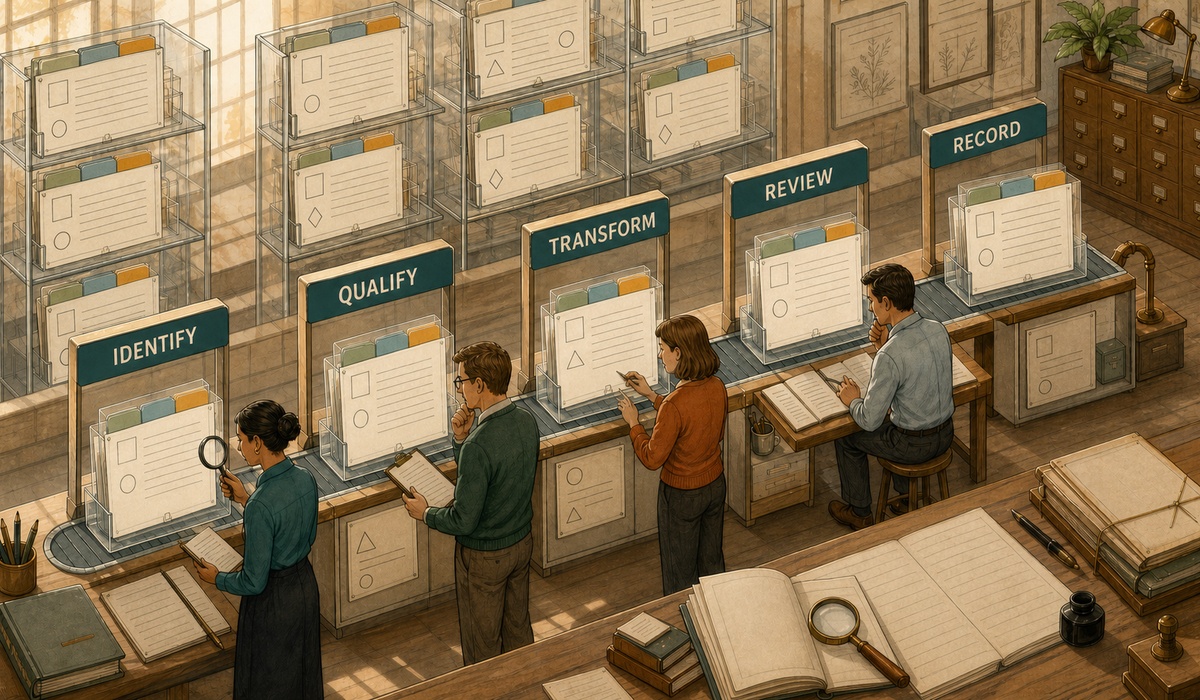
A Five-State Lifecycle for Versioned Content
The following lifecycle treats content as something that moves through states. It is intentionally stricter than “find, copy, paste.”
State 1: Identify
Give the content unit a stable identity and enough metadata to distinguish it from similar material. Document type, component type, language, code, and name are useful starting fields. Identity prevents two almost-identical paragraphs from becoming indistinguishable search results.
State 2: Qualify
Before reuse, verify the version, source context, data cutoff, intended audience, and any governing instructions. Qualification is a human decision. A “latest” flag is helpful, but it cannot decide whether latest also means applicable.
State 3: Transform
Define what changes when content crosses contexts. The first-level heading may need to disappear. Section numbering may need to follow the target document. Tense, terminology, references, and explanatory depth may also change. Record the transformation rather than pretending the copied words were unchanged.
State 4: Review
Review the transformed result inside the destination document. This is where scientific meaning, consistency, and local fit are checked. Approval of the source content should inform the review; it should not replace it.
State 5: Record
Preserve enough history to explain which version was used, what changed, and what became part of the target document. Recording closes the loop. Without it, the next reuse begins with the same questions.
| Lifecycle state | Minimum evidence | Human decision |
|---|---|---|
| Identify | Stable code, name, type, language | Is this the intended content object? |
| Qualify | Version, source context, applicable instructions | Is it suitable for this use? |
| Transform | Mapping and change method | What must change, and what must remain? |
| Review | Destination-document comparison | Is the transformed text correct here? |
| Record | Version and change history | Can another reviewer reconstruct the decision? |
This five-state model is a practical tool, not a regulatory standard. Teams should adapt its evidence fields and approvals to their document types, procedures, and intended use.
How AuroraPrime RMA Handles Content Units and Reuse
AuroraPrime RMA documentation describes a Content Library that organizes content units in a tree-view folder structure, typically by document type and component type. Each opened content unit has three panels: information and metadata, a content preview, and a history area with Change Requests and Versions. The documented history view provides an audit trail of the unit.
That design supports two important lifecycle states: identity and record. It does not, by itself, prove that a content unit is scientifically current or approved for every downstream document. The qualification and review decisions still belong to accountable people and procedures.
The AuroraPrime RMA Add-In also documents a reuse workflow for content from existing documents. Writers can upload one or more documents, preview selected sections, and insert chosen content into the destination. During insertion, the first-level chapter title is removed, inserted section titles and numbers are adjusted to the current document, and revision history is retained when insertion occurs in revision mode.
Template-configured mappings can also match sections between document types and insert mapped content into corresponding target sections. That is a concrete transformation mechanism. It should be evaluated with the same question as any automation: does the mapping capture the intended relationship for this document pair, or merely a convenient similarity?
At project level, the documented centralized Document Library organizes associated materials such as clinical study reports, protocols, Statistical Analysis Plans, Investigator’s Brochures, Company Core Data Sheets, and Development Safety Update Reports. It also warns users when they attempt to delete a document version that is currently in use. That warning is small but useful; deletion is a lifecycle event, not housekeeping.
For related reading, see health-authority question reuse with AI, low-code AI templates for regulatory authoring, and cross-document intelligence for eCTD summaries.
A Practical Reuse Decision Table
Before inserting approved content into a new document, classify the reuse. The classification gives reviewers a shared expectation about how much change and checking are reasonable.
| Reuse type | Typical example | Expected action | Review intensity |
|---|---|---|---|
| Exact-context reuse | Same approved wording in the same document type and context | Verify version and insert | Focused |
| Mapped reuse | Source section moves to a defined target section | Apply mapping and inspect structure | Moderate |
| Transformative reuse | Protocol wording becomes CSR past-tense narrative | Record transformation and review meaning | High |
| Evidence-dependent reuse | Text depends on updated data or analyses | Reconfirm source evidence before drafting | High |
| Reference-only reuse | Prior wording informs a new passage | Treat as source material, not approved output | Author-led |
Two edge cases deserve special attention. First, a newer version can be less appropriate than an older one if the newer content belongs to a different indication, region, or data cutoff. Second, exact wording can still be wrong after relocation because a reference such as “this section” or “the analysis above” has changed meaning.
The useful question is not “Can the platform reuse this?” It is “What evidence would make this reuse defensible?” That question turns a feature into an operating control.
Frequently Asked Questions
What is a versioned content unit?
A versioned content unit is a reusable block of content with a stable identity, metadata, content, and change history. Its version helps reviewers understand which state was reused, while its context and instructions help them decide whether that state is suitable for the destination document.
Is approved content safe to reuse without review?
No. Approval is tied to an earlier context. The reused content may need changes to tense, references, terminology, data cutoff, document structure, or audience. A reviewer should confirm both scientific correctness and destination-document fit.
How does AuroraPrime RMA support content reuse?
Local documentation describes content units with metadata, preview, change-request, and version history views; section preview and insertion from existing documents; template-configured section mappings; revision-history retention; and project-level management of associated documents.
Does a content library guarantee traceability?
No. A library provides a place to organize content and history. Traceability depends on the metadata captured, the version selected, the transformation recorded, and the review decision made in the destination context.
Conclusion
A mature pharma r&d document automation solution should make content easier to reuse without making reuse casual. The safest object is not a perfect paragraph frozen in a library. It is a versioned content unit whose identity, context, transformation, and history can be inspected.
AuroraPrime RMA documentation shows concrete building blocks for that approach: content-unit metadata and history, document and section previews, controlled insertion behavior, template mappings, and warnings around in-use document versions. The operating model still matters. People must decide whether a particular version belongs in a particular document.
To explore versioned content and document-reuse workflows in AuroraPrime RMA, contact AlphaLife Sciences.
