




Precision at Scale Engineering CTD Module 2.7.3 and 2.7.4 Clinical Summaries with AI
May 05, 2026Streamline CTD Module 2.7.3 and 2.7.4 authoring with AuroraPrime RMA. Learn how AI harmonizes cross-study data for accurate, submission-ready clinical summaries.
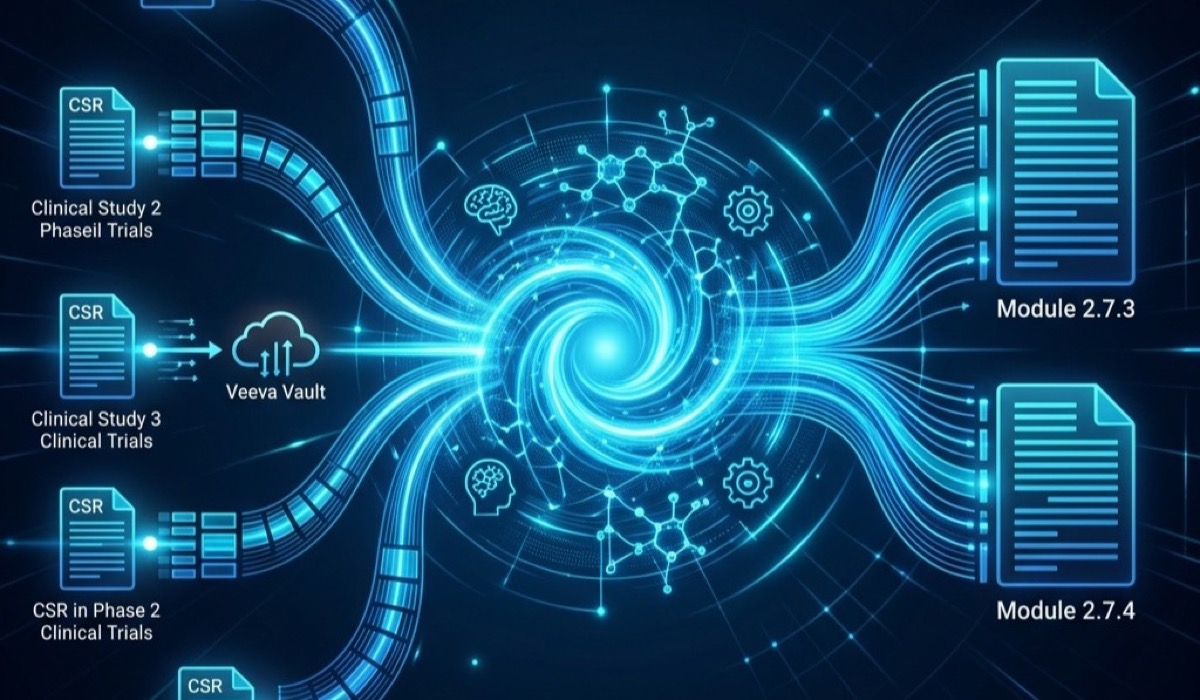
In a typical regulatory submission, the Clinical Study Report (CSR) takes center stage. But the real weight of a clinical program lives in the Clinical Summaries. CTD Module 2.7.3 (Summary of Clinical Efficacy) and CTD Module 2.7.4 (Summary of Clinical Safety) are where the "big picture" emerges—where data from various studies finally meets to tell a unified story.
For years, pulling these summaries together has been a grueling manual process. Medical writers spend hundreds of hours copy-pasting data, double-checking TFL numbering, and trying to spot efficacy trends across disparate trials. It’s tedious, and it’s where errors most often slip through.
At AlphaLife Sciences, we’ve built a better approach. By using AI Regulatory and Medical Authoring through AuroraPrime RMA, teams are changing how they tackle Module 2. This post is for the regulatory leads and medical writers who need to move faster without compromising the scientific depth of their summaries.
The Reality of Data Harmonization in Module 2
The difficulty with a Summary of Clinical Efficacy (SCE) or Summary of Clinical Safety (SCS) isn't just the sheer volume of data. It’s the aggregation. Whether you’re dealing with different dosing cohorts or rolling up global Phase 3 results, the bottlenecks are almost always the same:
1. The TFL Reconciliation Trap
Each CSR has its own TFL Summaries. By the time you reach Module 2, you have to merge these tables or present them in a way that makes sense side-by-side. Doing this in Word is where precision goes to die.
2. The Data Integrity Gap
If a single data point changes in an underlying CSR late in the game, it has to ripple all the way up to the Clinical Summary. Without a centralized system, this creates a massive QC burden for everyone involved.
3. The Struggle for Synthesis
Reporting raw results is straightforward. Explaining why one study showed a different safety profile than another is a high-level scientific challenge. Traditionally, this has been an entirely manual narrative task.
Mastering CTD Module 2.7.3: The Efficacy Narrative
An effective CTD Module 2.7.3 Summary of Clinical Efficacy needs to do more than list response rates. It has to show how those rates hold up across the program. AuroraPrime RMA simplifies this by:
Batching TFLs from Multiple Sources: You can connect to a TFL Source Data Directory that pulls from all your trials at once. RMA’s AI Recommendation engine then helps place these tables into the SCE structure automatically.
Generating Cross-Study Drafts: Using the Lean Summary (GenAI) method, RMA analyzes tables from multiple trials to draft narratives that highlight consistent efficacy trends.
Ensuring Constant Sync: When a pivotal trial’s ITT analysis updates, the Sync TFLs feature carries that change through to your SCE. You don’t have to hunt down every instance of "stale" data.
Mastering CTD Module 2.7.4: The Safety Profile
For CTD Module 2.7.4 Summary of Clinical Safety, precision is everything. Patient safety and integrated summaries of safety (ISS) allow no room for error. RMA helps by:
Harmonizing Safety Reporting: You can merge adverse event tables from different regions into one view using our Edit View interface. This ensures the safety message is consistent across the whole summary.
Handling the Acronym Heavy-Lifting: Safety summaries are thick with jargon. RMA’s Generate Abbreviation List scans the doc to ensure everything from ITT to ICC is defined correctly and matches your source data.
Aligning the Synopses: The safety summary often echoes individual CSR synopses. RMA can batch-draft these sections to ensure your high-level takeaways in Module 2 are in lockstep with the detailed reports in Module 5.
The AuroraPrime Difference: Integration That Actually Works
AI is powerful, but it’s the integration that makes it useful for pharma.
Veeva Vault RIM Integration
Most teams struggle with document versions. Our Veeva Vault RIM Integration pulls your source protocols and CSRs directly from your system. This creates a traceable path from the initial evidence to the final summary.
Life-Sciences Native AI
We didn’t just wrap a chatbot in a UI. AuroraPrime RMA is built for life sciences. Our AI Augmentation Strategy uses prompts tailored for regulatory language, and we strictly follow the "No Data Manipulation" rule. The AI handles the words, but the TFL data remains locked and untouched.
FAQ
How does RMA keep data accurate in Module 2?
RMA links directly to your TFL Source Data Directory. The AI doesn't "hallucinate" numbers; it extracts them from the same RTF/CSV files your biostatistics team has already QC'd.
Can it handle 10+ studies in one summary?
Yes. The Managing Associated Docs feature lets you link as many trials as you need to a single project. The AI can then aggregate content from that entire library to build your SCE or SCS.
Is the output submission-ready?
Yes. Our templates follow TransCelerate and ICH standards, so your headers and structure are ready for eCTD submission from day one.
Conclusion
The days of grueling manual data entry for CTD Module 2.7.3 Summary of Clinical Efficacy and CTD Module 2.7.4 Summary of Clinical Safety are over. By bringing AI Regulatory and Medical Authoring into your process, you can reclaim significant time for your writers—letting them focus on the science instead of the formatting.
If you’re ready to see how your team can move faster, we’d love to show you.
Book a demo of AuroraPrime RMA: https://alphalifesci.com/contact-us
