




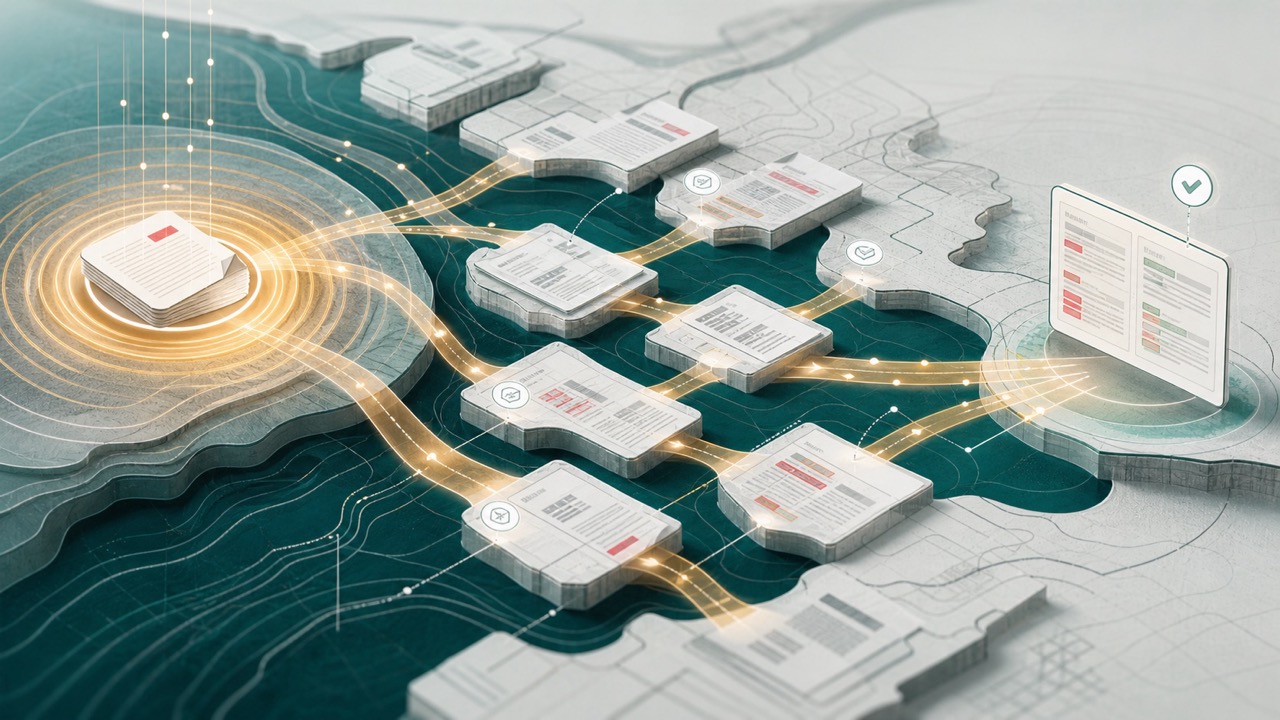
The Amendment Problem Is a Ripple Problem
This article is for clinical development, medical writing, regulatory operations, and quality teams evaluating ai protocol writing software for protocol amendments. The short answer: amendment workflows need change impact intelligence, not just faster redlines.
Protocol amendments are rarely isolated edits. A modified objective can affect endpoints. A changed procedure can affect the Schedule of Activities, informed consent language, safety monitoring, visit descriptions, and site instructions. A revised Investigator's Brochure can alter risk language across multiple sections.
The writer's work is not simply to update a paragraph. It is to understand the ripple. That is why manual amendment work feels disproportionate: 1 upstream change can create 10 downstream questions.
Why File Comparison Is Not Enough
Document comparison tells you what changed between two versions. It does not always tell you why the change matters, which other sections are affected, or what update should be proposed.
A useful amendment workflow needs 5 steps:
| Step | Question | Output |
|---|---|---|
| Detect | What changed upstream? | Source change evidence |
| Assess | Which protocol sections are affected? | Impacted-section list |
| Plan | What update is needed? | Proposed change plan |
| Generate | What draft text should change? | Section-level replacement |
| Review | Is the update acceptable? | Diff and human approval |
Without these steps, teams rely on manual cross-checking. That is slow, but the larger problem is unevenness. One reviewer may catch the affected endpoint table. Another may miss downstream operational text. AI should not remove expert review; it should make the review target sharper.
How AuroraPrime RMA Supports Amendment Intelligence
AuroraPrime RMA documentation describes protocol amendment suggestions that are triggered by uploading a modified snapshot or Investigator's Brochure version, producing specific amendment suggestions for each content control directly within Word.
Release documentation also describes a Source Tracing view that lets authors see exactly which upstream document changes triggered recommended updates. The interface can display the source trigger, impact judgment, edit scope, preservation setting, review note, original content, suggested updated content, and AI prompt used for the suggestion.
That is the operating model amendment teams need. Not "trust the AI." Not "accept all changes." Instead: show me what changed, show me what it affects, show me the proposed update, and let me inspect the diff before anything enters the protocol.
For protocol generation more broadly, AuroraPrime RMA can generate content section by section and automatically insert it into corresponding template locations. The same section-level logic is essential in amendments. You do not want a changed IB version to rewrite the entire protocol. You want a governed update path for affected content.
What Teams Should Measure in a Pilot
For a sponsor or CRO piloting a pharma ai authoring platform for amendments, the success metric should not be "AI produced text." That bar is too low.
Measure at least 6 outcomes:
Time from upstream source change to impacted-section list.
Percentage of true impacted sections identified.
Number of false-positive impacted sections requiring dismissal.
Time spent reviewing proposed updates versus manually drafting them.
Frequency of unresolved assumptions or missing-input prompts.
Quality of the final diff after human review.
The best pilots include difficult examples: conflicting source updates, partial study-design changes, revised SoA timing, changed inclusion criteria, and late statistical clarifications. Easy amendments make every tool look good. Hard amendments reveal whether the workflow understands the document.
There is also a cultural shift. Teams should stop treating amendment work as clerical cleanup and start treating it as change intelligence. The protocol is a network. The amendment workflow should behave like it knows that.
Frequently Asked Questions
What is change impact intelligence for protocol amendments?
Change impact intelligence identifies upstream source changes, maps them to affected protocol sections, proposes updates, and gives reviewers evidence and diffs before insertion.
Why is document comparison insufficient for protocol amendments?
Document comparison shows textual differences, but it may not explain downstream impact, affected sections, source rationale, or what update should be made.
Can AI help update only affected protocol sections?
Yes. A section-level workflow can target impacted sections instead of regenerating unrelated content, preserving manual edits and reducing review burden.
Should AI execute amendment updates automatically?
For regulated protocol authoring, the safer model is AI-assisted recommendation plus human review. The system can suggest and draft, but authors approve what enters the document.
What source changes commonly trigger protocol amendments?
Common triggers include updated Investigator's Brochure language, revised study design assumptions, protocol synopsis changes, safety updates, endpoint changes, and SoA modifications.
Conclusion
Protocol amendments expose the hidden architecture of a clinical document. Every change asks the same uncomfortable question: what else moved?
A serious ai platform for pharma regulatory authoring should help teams answer that question. AuroraPrime RMA supports an amendment model built around upstream change detection, section-level suggestions, source tracing, review notes, and human-controlled insertion. That is change impact intelligence, and it is far more useful than another manual rework cycle.
To explore AI-assisted protocol amendment workflows, contact AlphaLife Sciences at https://alphalifesci.com/contact-us.
