




Revolutionizing Clinical Documentation What’s New in the April 2026 Release of AuroraPrime RMA
Mar 31, 2026🚀 Clinical documentation is evolving faster than ever—and the April 2026 AuroraPrime RMA release marks a defining shift in how teams across regulatory, medical, and clinical domains work. From smarter automation to deeper scientific context awareness, this update shows what happens when AI is engineered for real-world impact, not just efficiency.📈 Whether you're driving submission readiness, scaling evidence generation, or strengthening quality oversight, these new capabilities point to a future where teams spend less time wrestling with documents and more time advancing meaningful science.🔍 Curious how this release pushes the boundaries of what AI can do in regulated content workflows—and what it means for your organization’s 2026 roadmap?
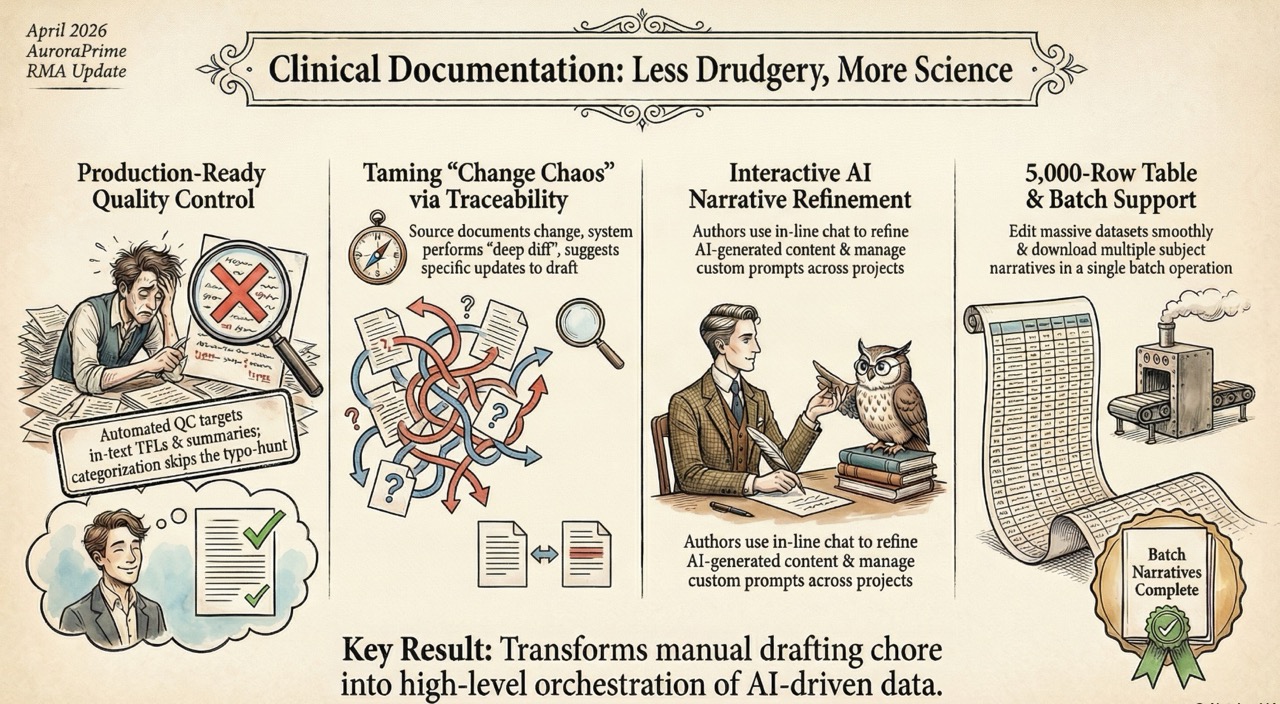
As clinical pipelines expand and regulatory expectations grow, medical writing and clinical operations teams face immense pressure to deliver accurate, compliant documents faster than ever. At AlphaLife Sciences, we understand that true efficiency isn't just about generating text—it's about orchestrating the entire drafting, reviewing, and updating process.
That is why AuroraPrime RMA continues to evolve as a game-changing tool for regulatory document generation. With our latest April 2026 Release (Release 2026.03.29), we are introducing powerful new capabilities designed to eliminate manual bottlenecks, enhance quality control, and keep your clinical narratives perfectly aligned with your source data. Let’s explore the highlights of this exciting update and see how AI can make your documentation process faster, easier, and more compliant.
1. Production-Ready Quality Control (QC)
Reviewing complex Clinical Study Reports (CSRs) for accuracy and consistency is notoriously time-consuming. We are thrilled to announce that our Quality Control (QC) module is now available for production use. Writers can now run automated QC tasks specifically targeting In-Text TFLs and TFL Summaries. The system intelligently categorizes findings by document section and tracks their status as active or closed, allowing you to focus directly on resolving specific clinical entity issues rather than hunting for typos.
2. Mastering "Change Chaos" with Upstream Source Traceability
One of the biggest headaches in medical writing is managing updates when an upstream source document changes mid-draft. To solve this, the RMA add-in now features automated document version notifications that check for new versions of associated documents upon launch. When an updated source document is detected, the system performs a deep comparison to distinguish between substantive content changes and minor formatting tweaks.
In our Clinical Summary workflow, the new Source Tracing view provides a side-by-side diff showing exactly which upstream changes triggered recommended summary updates, complete with detailed reasoning. Authors can then apply these updates directly into their document, ensuring summaries stay perfectly aligned with the latest CSR content without the need to manually reread the entire source.
3. Smarter AI Authoring and Interactive Refinements
We are giving teams unprecedented control over how our AI generates clinical content. Administrators and users can now manage additional AI prompts across Organization, Project, and Personal levels, ensuring company-wide standards while allowing individual flexibility.
Additionally, keeping the strategic narrative consistent across documents is easier with our new in-line key message management. Authors can manage and add strategic messages—like core efficacy findings and safety conclusions—on the fly, enabling the AI to weave these approved messages throughout the submission package. If the generated draft isn't quite perfect, our new AI chat integration allows users to initiate an interactive chat directly on the generated results to ask follow-up questions and request immediate refinements.
4. Accelerating Everyday Administrative Workflows
We’ve also streamlined the tedious administrative tasks that slow down document assembly:
Standardized Abbreviations: The Abbreviation Normalization feature now supports more core documents, including CSRs, Informed Consent Forms (ICFs), Lay Summaries, and Study Protocols, ensuring consistent terminology across your entire portfolio.
Batch Narrative Downloads: Safety writing teams can now select multiple subjects and download their individual safety narratives in a single batch operation.
Flexible CIOMS Uploads: CIOMS files can now be uploaded incrementally across multiple sessions, automatically triggering background parsing without needing all files at once.
Large Table Handling: We’ve enhanced performance for massive datasets, allowing users to smoothly edit source tables containing up to 5,000 rows.
What's Next?
The April 2026 Release of AuroraPrime RMA represents a significant leap forward in AI-augmented clinical authoring. By combining intelligent content generation with robust traceability and automated quality checks, we are empowering medical affairs and regulatory teams to focus on high-value scientific interpretation rather than administrative data assembly.
Ready to experience a faster, more compliant documentation process? Check out the full release notes in the AuroraPrime RMA User Guide to explore every new feature, or reach out to our team today to schedule a live demo of the new update!
