




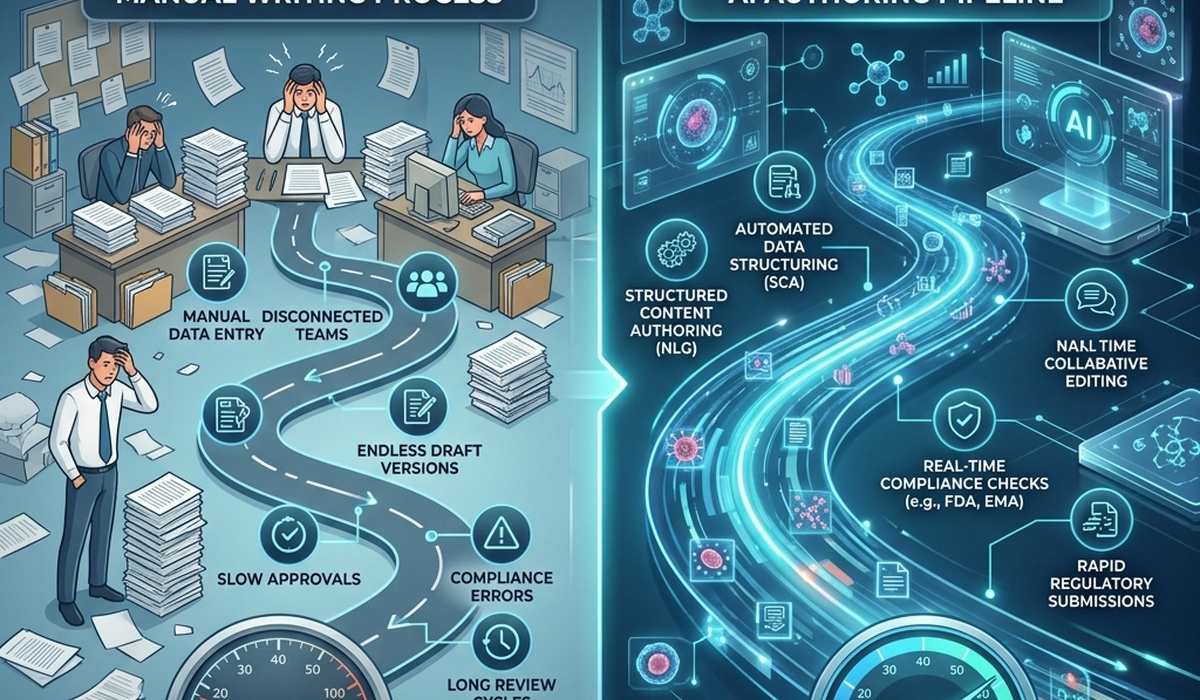
The life sciences sector has rapidly modernized how it discovers drugs, runs clinical trials, and synthesizes molecules. Yet, when it comes time to report those findings to regulatory agencies, the industry often reverts to an antiquated process: dozens of writers manually assembling documents in disconnected word processors.
This paradigm is changing. The rise of AI Regulatory and Medical Authoring is fundamentally shifting medical writing from a reactive, manual task to a predictive, automated workflow.
The False Choice: Speed vs. Compliance
Historically, regulatory teams faced an impossible choice. If they pushed to get the Clinical Study Report (CSR) or Quality Overall Summary (QOS) done quickly, they risked introducing minor inconsistencies—like a mismatched adverse event number—that could trigger a costly regulatory query.
Conversely, achieving 100% compliance through manual Quality Control (QC) delays submissions by weeks. Every day a submission is delayed, millions of dollars in potential revenue are lost, and more importantly, patients wait longer for life-saving therapies.
Overcoming the Trade-off with GenAI
Generative AI, when trained specifically on regulatory guidelines, destroys this trade-off. Platforms like AlphaLife Sciences's AuroraPrime RMA allow sponsors to achieve unprecedented authoring speed without sacrificing compliance.
1. The Power of the Single Source of Truth
One of the core reasons fast authoring fails is disconnected data. AuroraPrime RMA solves this through its Veeva Vault RIM Integration. Instead of writers referencing outdated PDFs downloaded to their desktops, the AI engine pulls data directly from the live Vault. If a data point updates in the source, the AI knows, ensuring your documents are always reflecting the current, approved reality.
2. Intelligent Content Generation
AI Regulatory and Medical Authoring goes far beyond grammar checks. AuroraPrime RMA reads a 300-page protocol and instantly drafts the corresponding sections for the Investigator's Brochure or Informed Consent Form. It understands the context of the data, recognizes trends in adverse events, and formats tabular data perfectly.
3. Automated CMC Workflows
For manufacturing teams, CMC Automation represents a massive leap forward. The AI can pull complex batch records, stability data, and analytical procedures to instantly populate the CTD Module 3 documents, all while formatting the data strictly to ICH M4Q guidelines.
Frequently Asked Questions
Is AI authorized for regulatory submissions?
Regulators evaluate the scientific validity of the data and the accuracy of the submission, not the software used to draft it. Because AuroraPrime RMA relies on verifiable source data and human-in-the-loop oversight, it meets all regulatory standards.
How does integrating with Veeva Vault RIM help?
It ensures data provenance. Whenever a document is generated, the AI links back to the exact file in Veeva Vault, creating an instant audit trail that makes QC review exponentially faster.
Conclusion
The future of medical writing is not typing; it's reviewing, strategizing, and synthesizing. As competition intensifies, AI Regulatory and Medical Authoring is no longer a luxury—it is necessary infrastructure.
By eliminating manual transcription and harnessing active data integrations, life sciences companies can finally submit with absolute confidence and unprecedented speed.
Discover the future of medical authoring today: https://alphalifesci.com/contact-us
