




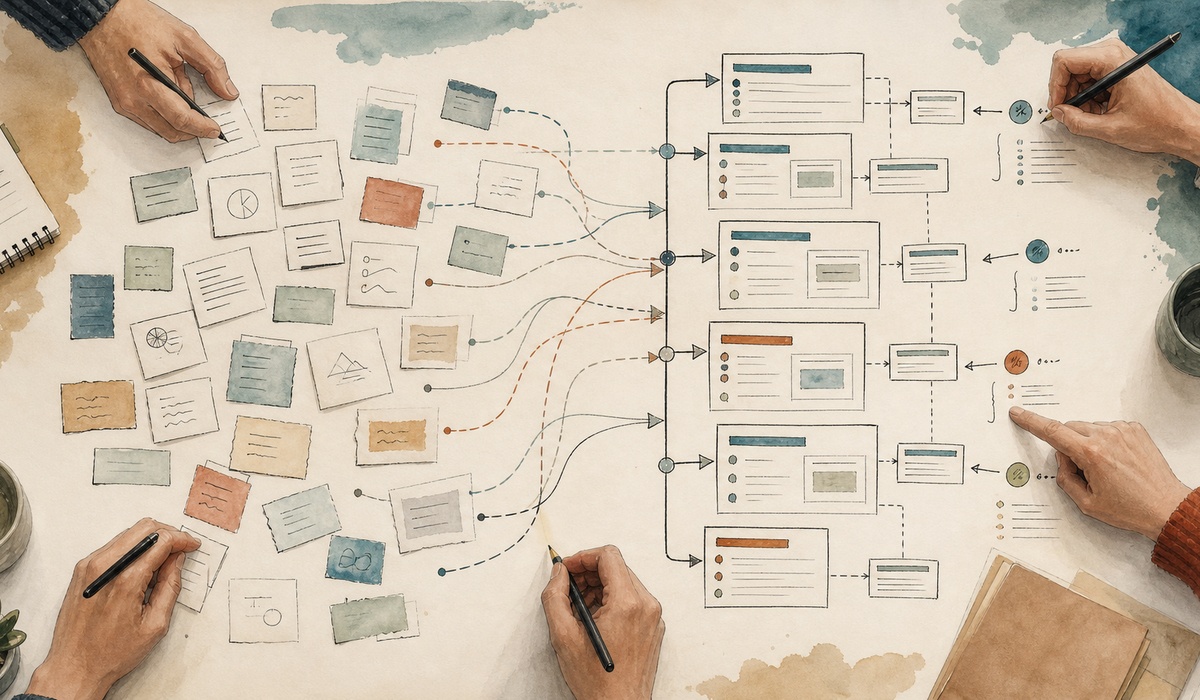
Key takeaway: A transition toward new CMC structures starts with content inventory, ownership, content relationships, and reuse rules. Technology can support the work, but it cannot decide how a sponsor should interpret or reorganize its regulatory knowledge.
This article is for CMC and regulatory transformation leaders evaluating AI CTD authoring software. It addresses a recurring mistake: treating a standards transition as a file-conversion exercise. Documents are containers. The hard work lies in the claims, tables, content relationships, and decisions contained within them.
Why format conversion is not enough
If you simply move text from one heading to another, you may preserve old ambiguity in a new layout. If you recreate content manually, you may introduce drift. Neither path answers the core questions:
What is the approved statement?
What information underpins it?
Where else is it reused?
Who owns a decision when the content must change?
The opportunity is not to automate a rearrangement. It is to make regulated content more modular, inspectable, and reusable without sacrificing expert judgment.
Begin with a content inventory
Before any content transformation, create a small, practical inventory for the selected scope. A useful record has six fields:
| Field | Why it matters |
|---|---|
| Content unit | Defines what is being moved or reused |
| Current location | Preserves the dossier context |
| Supporting information | Gives reviewers the necessary context |
| Proposed destination | Makes the transition testable |
| Owner | Prevents an orphaned decision |
| Status | Shows whether the unit is draft, reviewed, approved, or retired |
This is a modest task, but it changes the conversation. A team stops asking the abstract question “Can AI migrate this?” and starts asking which units are stable, which require interpretation, and which should remain outside the first wave.
What an authoring platform can contribute
AuroraPrime supports AI-assisted information extraction, template design, connected drafting, relationship visualization, CTD-aligned initialization, and M3/M2.3 generation workflows. It also provides configurable generation rules, a centralized Document Library, reusable content, review comments, tracked changes, and QC findings.
Those capabilities can support a disciplined content-transition process. They do not mean that a given organization has achieved a new standard, that every legacy dossier can be transformed automatically, or that the platform provides native structured outputs outside its current scope. Those are implementation questions that need a defined target state and a pilot.
Run the transition as a learning program
Pick one limited CMC content domain. Define the approved material for that scope. Map ten to twenty representative content units. Ask two reviewers to independently assess the proposed destination and reuse logic. Then study the disagreement.
That disagreement is useful. It shows where the organization’s implicit conventions are not yet explicit enough for reusable structured content. It may point to missing controlled vocabulary, unclear ownership, inconsistent content, or a template that needs revision.
AI is helpful here when it accelerates discovery and helps organize the work. It is unhelpful when it makes unresolved policy choices look automatic.
The leadership move is to protect meaning
The best transformation leaders do not chase a dramatic migration number. They protect the meaning of high-value content as it moves through a new model. That requires regulatory expertise, CMC expertise, information architecture, and quality involvement from the start.
The benefit is larger than a single transition. Once teams know what content they can use, how it connects, and who maintains it, every later authoring cycle gets easier to govern.
Frequently Asked Questions
Can AI automatically convert all legacy CMC content into a new structure?
AI can assist with extraction, mapping proposals, and drafting. Sponsors should validate the target structure, content suitability, and human review steps for the intended content and regulated use.
What content should be in the first pilot?
Choose a bounded area with meaningful reuse potential, approved material that is easy to access, named subject-matter owners, and a clear acceptance test. Avoid using the pilot to solve every content-management problem at once.
Does a new template make content structured?
No. A template gives content a destination. Structured content also requires clear units, metadata, content connections, ownership, and reuse or change rules.
Treat transition as a chance to learn
The move to more structured CMC content can be a paperwork project. Or it can be a chance to clarify what the organization knows and how it keeps that knowledge trustworthy. The second path is harder, but it makes AI CTD authoring software far more useful.
To discuss a focused AuroraPrime RMA CMC content-transition pilot, contact AlphaLife Sciences.
