




The Narrative Thread: Why Cross-Module Intelligence is the Future of the eCTD
Apr 17, 2026Stop the eCTD silos. Discover how AuroraPrime RMA uses cross-module intelligence to maintain a consistent narrative thread across your entire submission.
Key Takeaways
Beyond Silos: The eCTD is a single story told across thousands of pages. Specialized AI ensures that story stays consistent.
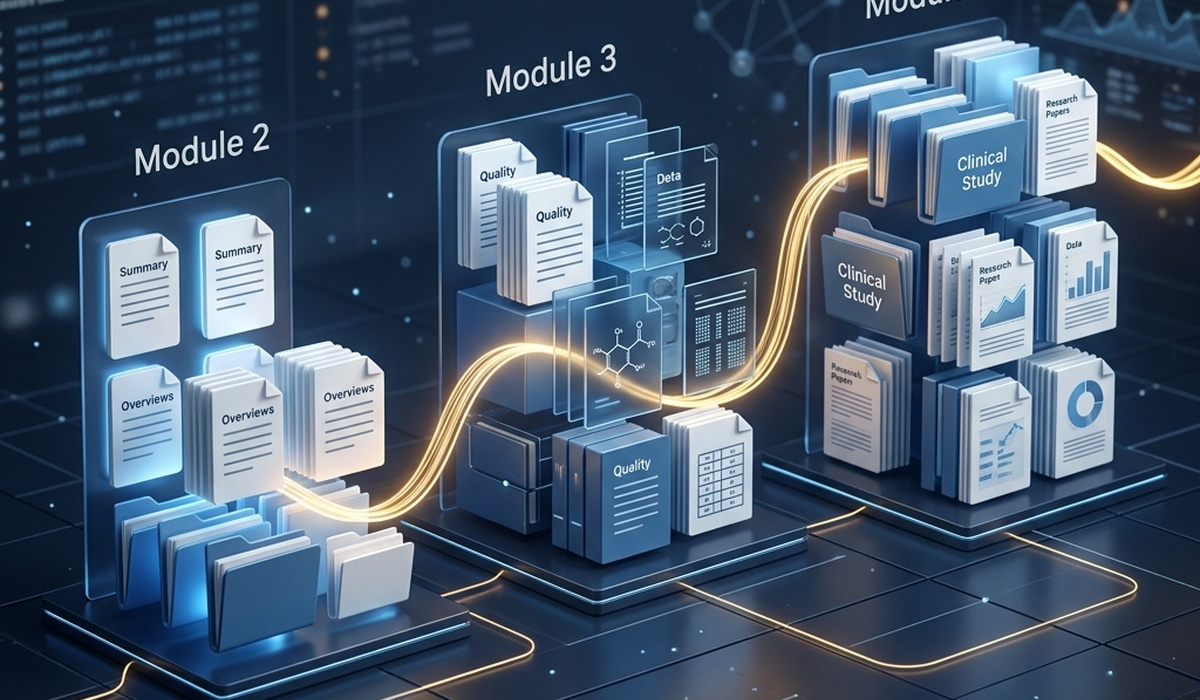
Cross-Module Intelligence: RMA platforms act as a central memory, verifying Module 2 summaries against the Module 5 source data in real-time.
Narrative Integrity: Automating the "boring" consistency checks reduces the risk of the contradictions that trigger regulatory queries.
Submission teams often treat the Electronic Common Technical Document (eCTD) like a series of separate hurdles. You’ve got the clinical team over here working on Module 5, the CMC team over there buried in Module 3, and a small group of medical writers in the middle trying to stitch everything together for the Module 2 summaries.
But a submission isn't just a collection of files. It’s a single, continuous scientific argument. Regulatory reviewers don't look at one module in isolation; they’re tracing the "narrative thread" that connects your early trial data to your final safety claims.
When that thread breaks—when a dosage mentioned in a Section 2.5 summary doesn't perfectly match the study protocol tucked away in Module 5—it creates friction. At best, you’re looking at a minor correction. At worst, you’re facing a "Refusal to File" (RTF) or a wave of Informational Requests (IRs) that can stall a drug’s approval for weeks.
The Exhaustion of Manual QC
Traditionally, we maintain this consistency through brute force. We hire "armies" of QC reviewers to spend days cross-referencing documents. They stare at screens for 12 hours at a time, checking that every mention of "Treatment-Emergent Adverse Events" matches across the entire submission.
The reality is that humans aren't built for this kind of granular, soul-numbing verification. We get tired. We miss things. And as submissions get more complex—especially with multi-indication drugs—the risk of data drifting apart increases every day.
This is exactly why we need a specialized AI writing solution for life sciences.
Moving to a "Shared Intelligence" Model
Imagine if your writing environment actually "remembered" what you wrote in other parts of the submission. Not just as blocks of text, but as connected data points.
With AuroraPrime RMA, we use AI regulatory and medical authoring to build what we call a shared intelligence layer. While you’re drafting the Module 2.5 Clinical Overview, the system is essentially "watching" the source documents in Module 5.
If you try to write a summary that contradicts the raw data, the system doesn't just flag it—it prevents the inconsistency from happening in the first place. It ensures the story stays the same from the first pre-clinical report to the final label.
The "Single Source of Truth" in Action
The secret to medical writing efficiency isn’t just writing faster. It’s writing smarter. By centralizing the intelligence layer, AuroraPrime RMA lets teams work in sync:
Global Sync: If you update a safety finding in one study, the system suggests those updates across every related summary.
Instant Audits: You can run a consistency check across the entire eCTD with one click, rather than waiting a week for a manual review.
Contextual Accuracy: The AI suggests content that’s already pre-aligned with your previously approved modules, so you never have to start from scratch.
| Feature | Legacy Siloed Authoring | AuroraPrime Cross-Module RMA |
|---|---|---|
| Data Scope | File-by-file | Global submission awareness |
| Consistency | Manual Human QC | Automated AI Audits |
| Narrative Flow | Often Fragmented | Continuous & Grounded |
| Submission Risk | High (Human Error) | Low (Data-Integrated) |
The Future is Threaded
The future of regulatory submissions isn't about better word processors. It’s about having a "submission brain"—a system that understands the connections between the different pieces of the eCTD puzzle.
By keeping the narrative thread tight through every module, we’re doing more than just saving time. We're making it easier for regulatory agencies to understand your data, trust your conclusions, and ultimately, say "yes."
Ready to connect your submission silos?
Frequently Asked Questions
Does this work across different writers in a team?
Yes. The intelligence layer is central to the project. Whether you have two writers or twenty, everyone is working off the same "Single Source of Truth."
Can the AI handle multi-indication submissions?
Absolutely. The system is built for complexity, mapping the relationships between multiple studies and their respective summaries across the global submission structure.
How does this change the QC workflow?
It moves the "check" to the "drafting" phase. By catching inconsistencies while you write, you dramatically shorten the final QC cycle, often by 50% or more.
