




Translating Science for Patients - AI-Driven Lay Summary Generation
Mar 16, 2026Translating dense clinical language for patients doesn't have to be a headache. See how AuroraPrime RMA transforms raw clinical data into accessible Lay Summary / Plain Language Summary documents.
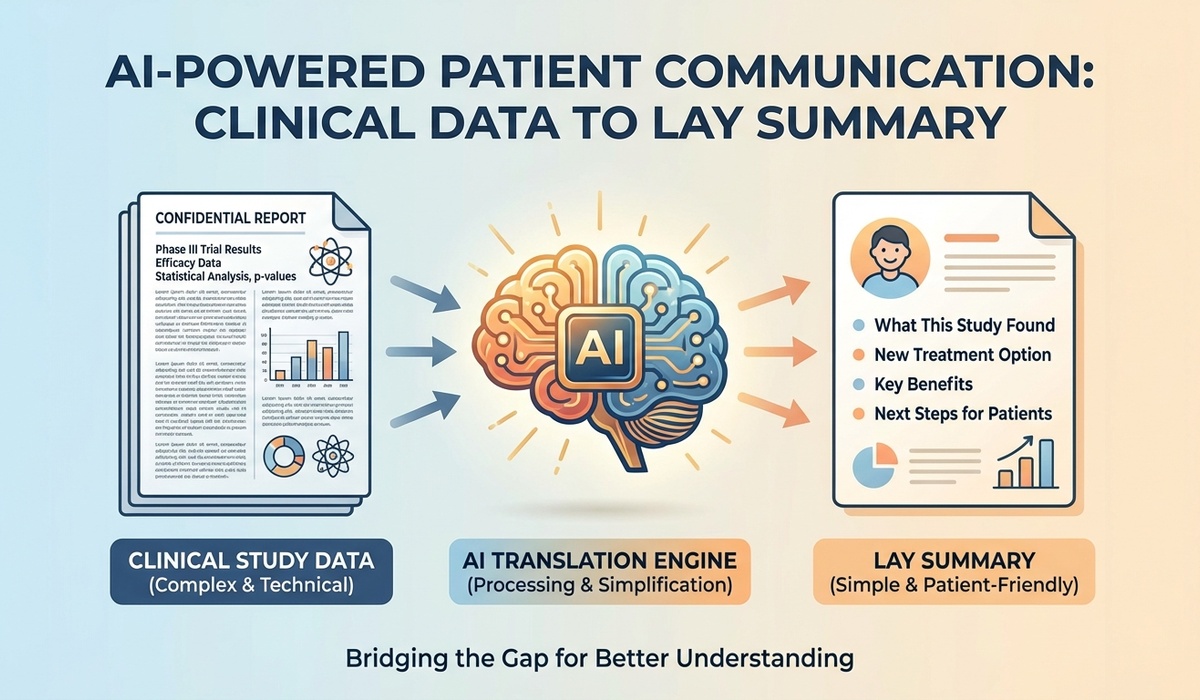
The clinical research industry has recently undergone a major, much-needed cultural shift: actually putting the patient at the center of the dialogue. As regulatory agencies increasingly mandate patient-centric documents in submissions, life sciences organizations are colliding with a unique challenge. How do you accurately take complex clinical outcomes—the kind buried deep within Protocol & Protocol Amendments and heavy statistical sections—and present them so non-medical professionals can easily understand them?
Writing a solid Lay Summary / Plain Language Summary is practically required for operational transparency and patient trust. Yet, the mental gymnastics required to translate high-level clinical jargon into accessible, everyday language is notoriously difficult.
But what if AI could act as your dedicated clinical translator?
By leaning on an AI Regulatory and Medical Authoring platform like AlphaLife Sciences' AuroraPrime RMA Add-In, clinical teams can systematically transform their hardest-to-read study findings.
Here’s what we’re digging into today:
The hidden headaches of drafting an effective Lay Summary / Plain Language Summary
How AuroraPrime uses AI extraction to synthesize dense clinical reports
Why automated Lay Term Glossary management is a total lifesaver
A few best practices to speed up your patient-centric documentation
The Complexities of the Plain Language Shift
Writing a Lay Summary / Plain Language Summary essentially requires medical writers to become bilingual. They have to dissect the incredibly technical data found in CTD Module 5 Clinical Study Reports (CSR) and explain the core methodology, adverse events, and efficacy results. And they have to do it without dumbing down the science or sounding patronizing.
Managing Medical Glossaries
For a lay summary to actually work, every medical term (say, “myocardial infarction”) must be consistently swapped out for a plain language equivalent (like “heart attack”). Trying to manually control this vocabulary across a 20-page document is practically begging for human error and major review fatigue.
The Scope of the Clinical Investigation
The information you need for a lay summary isn't just sitting neatly in one underlying file. Writers have to continuously backtrack to original protocol designs, hunt through trial modifications detailed in Protocol & Protocol Amendments, and cross-check final statistical outcomes.
Automating Translation with AuroraPrime RMA
AlphaLife Sciences recognized that the best way to generate successful plain language documents is to connect intelligent generative AI directly to your source systems. With the AuroraPrime RMA Add-In for Microsoft Word, this workflow gets an instant, massive upgrade.
GenAI Source Extraction
Instead of staring down a dense, 200-page CTD Module 5 Clinical Study Reports (CSR) document and attempting a line-by-line rewrite, writers just initialize a draft draft right inside Word. The AI seamlessly scans the selected CSR synopses, pulls the vital context—study endpoints, participant demographic breakdowns, and outcome statistics—and drops them into predefined template locations.
The AI isn't just copy-pasting text. It's actively interpreting the core "Info elements" of a trial (like the "overall study objective") and generating a coherent narrative targeted specifically at a 6th to 8th-grade reading level—exactly what international health literacy organizations recommend.
The Lay Term Glossary Engine
One of the standout features of the AuroraPrime RMA Add-In is the integrated Lay Term Glossary. When setting up the document, writers just select a predefined company or therapeutic-area glossary.
As the AI Regulatory and Medical Authoring engine drafts the Lay Summary / Plain Language Summary:
It automatically scans the source material for complex medical terms.
It matches that terminology against the selected lay dictionary.
It seamlessly weaves the plain language equivalent into the generated text.
Pro Tip: To keep things actually readable, AuroraPrime RMA lets your team customize abbreviation display rules. For instance, you can set a rule to only display the plain-language term after the first full introduction to cut down on annoying repetitive clutter.
A Reliable Co-Authored Document
Generative AI isn’t here to replace human expertise; it acts as a highly capable co-author.
With AuroraPrime RMA, every generated section is totally reviewable. If the AI's lay description of an adverse event needs a little tweaking, writers can instantly open the Edit Rules and Regenerate panel. They can drop in specific "Additional Prompts" (like, "Use bullet points to describe the side effects") and just hit regenerate. The platform kicks out a side-by-side Diff view so writers can confirm the changes before finalizing the document layout.
Frequently Asked Questions
Can the layout of the Lay Summary / Plain Language Summary be customized?
Absolutely. The platform generates the document "In the Current Window" directly within Microsoft Word, leaning on your customized organizational template. This guarantees your corporate branding, table structures, and regulatory headers stay exactly where they belong.
How does the system handle complex data tables from CTD Module 5 Clinical Study Reports (CSR)?
AuroraPrime RMA's extraction model is trained to actually interpret tabular data structures within source documents. It intelligently summarizes them into plain descriptive language or simplified list formats, based perfectly on your specific generation prompt instructions.
Is the AI output reliable?
Because the platform relies on tightly controlled generative models bounded strictly by the referenced CSR synopses and managed lay glossaries, the output stays fully grounded in verified clinical reality. This practically eliminates the hallucinations you see in open-source consumer AI tools.
Conclusion
Translating rigorous science into an accessible Lay Summary / Plain Language Summary shouldn't be the bottleneck in your product lifecycle. By bringing in specialized AI Regulatory and Medical Authoring solutions, your medical writing team can easily guarantee compliance, drastically improve patient comprehension, and streamline regulatory submissions.
Ready to simplify patient communication? Check out how AuroraPrime RMA creates clarity from complexity and elevates your clinical documentation strategy.
