




Shaping the Future of Medical Writing: AlphaLife Sciences at EMWA Spring Conference 2026
May 11, 2026The future of medical writing is no longer a distant vision—it is being built right now through the power of generative AI. 🚀From the stages of the EMWA Spring Conference 2026, AlphaLife Sciences showcased how AI-accelerated authoring is moving beyond experimentation to deliver measurable impact across clinical and regulatory workflows. We are not just automating tasks; we are redefining the standards of precision, speed, and quality in life sciences documentation. 💡Whether you are navigating complex regulatory submissions or looking to streamline clinical reporting, the shift toward AI-augmented authorship is essential for staying ahead in an increasingly data-driven industry. Explore our key takeaways and see how we are leading the charge in this transformation. 🌐
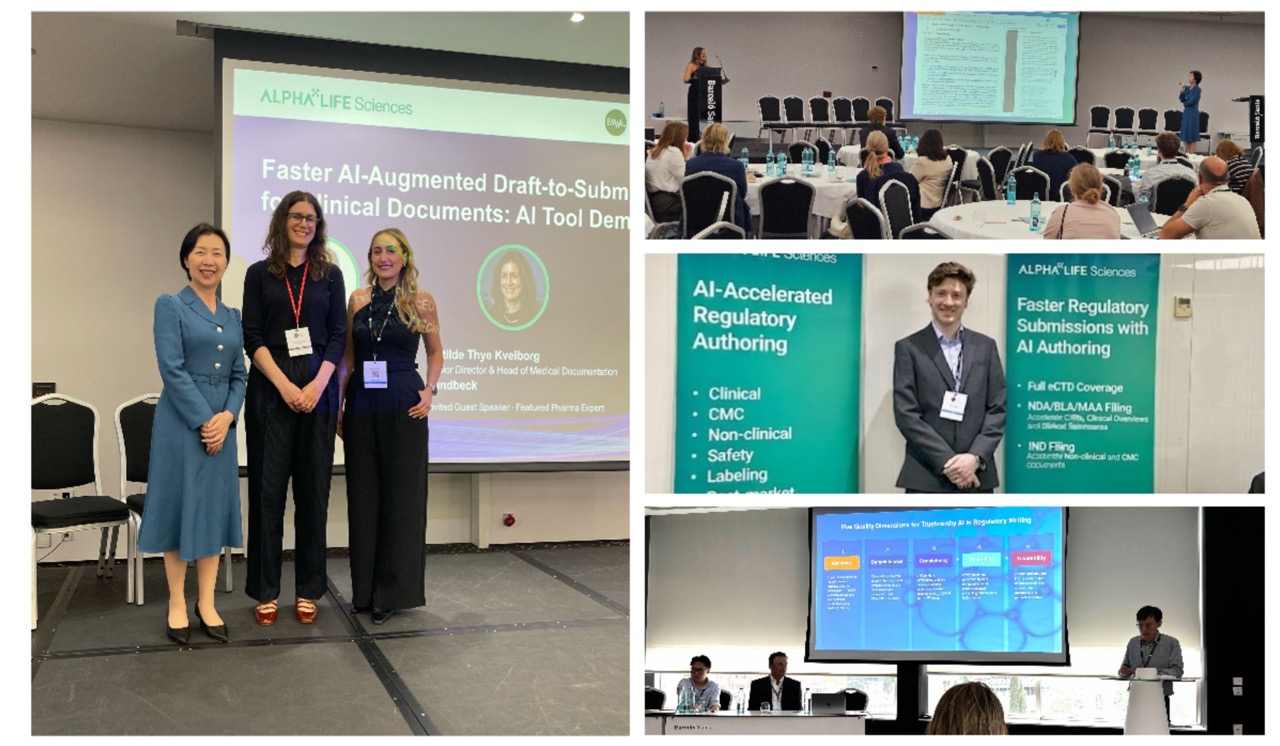
The European Medical Writers Association (EMWA) Spring Conference 2026 in beautiful Barcelona recently brought together professional biomedical communicators from 39 different countries. For AlphaLife Sciences, this event was the perfect stage to showcase how our AuroraPrime RMA platform is transforming clinical documentation and accelerating the clinical trial lifecycle. We were thrilled to connect with the global medical writing community at Booth 1 and host two engaging sessions that explored the intersection of artificial intelligence, regulatory compliance, and the evolving role of the medical writer.
Inside the Black Box: Building Trustworthy AI
Our first session, "Inside the Black Box: Building Trustworthy AI Tools for Medical Writing," offered a deeply practical look at the foundational design of compliant artificial intelligence. Hosted by Dr. Namrata Singh, Founder and CEO of Turacoz, the discussion featured AlphaLife Sciences' Head of AI Product & Strategy, Mike Liang.
Together, they explored how AI must be purposefully architected to meet rigorous regulatory standards, highlighting the crucial need for medical writers to act as advisors during the development process. Mike emphasized that trust in regulatory AI is built on five core pillars: accuracy, completeness, consistency, factuality, and structural traceability. By exploring human-in-the-loop workflows, the speakers beautifully articulated a broader industry paradigm shift. Today's medical writer is rapidly evolving into a "scientist in the loop," an expert who strategically orchestrates and validates AI-generated narratives to ensure flawless compliance.
Accelerating the Draft-to-Submission Journey
Our Founder and CEO, Sharon Chen, took the stage for a highly anticipated session titled "Faster AI-Augmented Draft-to-Submission for Clinical Documents". Sharon was joined by Matilde Thye Kveiborg, Senior Director and Head of Medical Documentation at Lundbeck, and Lucia D'Amado, AI Product Specialist at AlphaLife Sciences.
Sharon's core message resonated deeply with the audience: AI should empower medical writers to dramatically accelerate the journey from first draft to final submission while keeping them firmly in control of content strategy and quality. Through live demonstrations, the AlphaLife team illustrated how AuroraPrime overcomes fragmented inputs and post-lock time pressures by orchestrating interconnected document networks. Key takeaways from the platform showcase included:
Measurable Cycle Time Reductions: GenAI capabilities can compress Clinical Study Report (CSR) drafting timelines from a traditional 8–14 weeks down to just 5–8 weeks, driving a 30% to 50% reduction in document cycle times.
Key-Message-Driven Authoring: By anchoring drafts directly to strategic key messages, writers can automate the heavy lifting. When upstream data changes, the system auto-refreshes the content while maintaining strict, QC-ready evidence traceability through live linkages.
Cross-CTD Orchestration: The platform seamlessly handles complex downstream adaptations, such as automatically generating site-level Informed Consent Forms (ICFs) from master protocols, and synthesizing clinical evidence into benefit-risk conclusions for M 2.5 Clinical Overviews.
Adding an invaluable industry perspective to these capabilities, Matilde shared insights from Lundbeck's successful GenAI structured authoring Clinical Trial Report (CTR) pilot using AuroraPrime. Replacing previous assumptions about AI's role, she presented three powerful takeaways for scaling GenAI across end-to-end regulatory submissions:
A Proven Foundation: The successful CTR pilot provided a strong "reason to believe" in AI's readiness and high text quality.
Strategic Acceleration: GenAI is not just about drafting a single document faster; it represents a strategic opportunity to shift the entire submission timeline forward.
The Human Element: The primary bottleneck to scaling these solutions is no longer technology, but rather capability building and behavior change within teams.
To overcome this bottleneck, Matilde emphasized the importance of a structured AI upskilling journey—focusing on testing, prompting frameworks, and knowledge sharing to turn initial inexperience into genuine "aha moments".
Looking Ahead
We left Barcelona feeling incredibly inspired by the conversations we had and the community's enthusiasm for embracing AI-driven innovation. A heartfelt thank you to everyone who visited our booth and actively participated in our sessions.
The future of medical writing is collaborative, intelligent, and highly efficient. If you missed us at the conference or want to explore our presentations further, we invite you to visit our event page at https://alphalifesci.com/events/emwa-spring-conference-2026. Discover how AuroraPrime can revolutionize your regulatory authoring workflows and help your teams bring life-saving therapies to market faster.
