




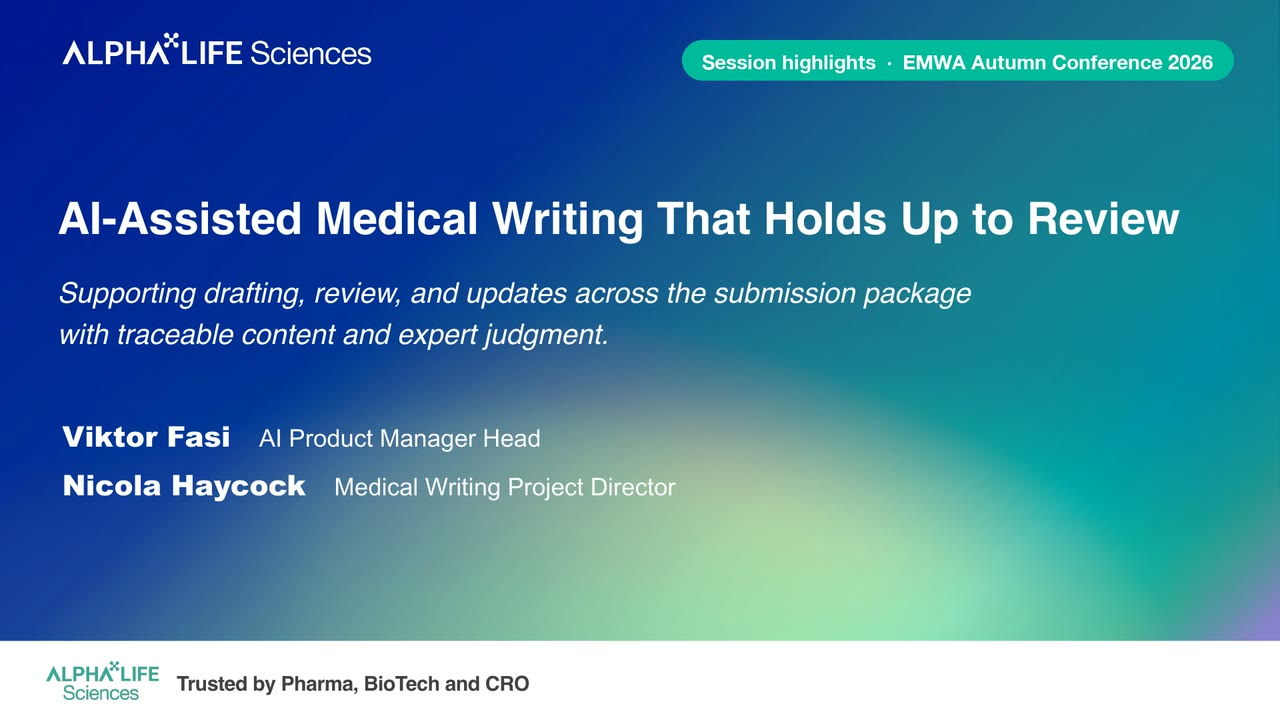

A strong draft gives reviewers a better place to start. At the EMWA Autumn Conference 2026 (online session), Nicola Haycock, Medical Writing Project Director, and Viktor Fási, AI Product Manager Head, both of AlphaLife Sciences, followed one clinical document from set-up to finalisation, exploring where AI can support drafting and review, and where the writer’s judgement matters.
If you have tried AI on a draft that read well but left you with more to verify, or want to know how it could change your day-to-day work, this session is for you. Leads who set up documents and manage review rounds will find it directly relevant.
What the full session covers
- Better drafts from the start. Start with the right template, sources and planned results. See the source behind the text and flag gaps for the writer to address.
- More focused review. Explore how specialist AI reviewers could flag issues with supporting evidence and bring conflicting comments together for the writer to resolve.
- Where the writer’s judgement matters. Six responsibilities that remain with the writer, what EMA and FDA expect from AI-assisted writing, and five things to try on Monday.
One document, seven stages
The session follows a clinical document from set-up and drafting through two review rounds, revision, QC, sign-off and submission. At each stage, it shows what AI could take on, such as proposing the plan, linking text to sources, merging reviewer comments and checking numbers, terms and references, and what stays with the writer, reviewers and approvers.
How specialist AI reviewers could work
We are designing AI reviewers that each read the draft against the sources with their own brief. The writer decides.
- Specialist reviews. Medical, statistics, safety, consistency and more, each with its own brief.
- One merged list. Each finding explains its basis and points to evidence a person can verify.
- The writer decides. Accept, edit or hold each finding. Nothing is applied automatically.
Featured speakers
Nicola Haycock, Medical Writing Project Director, AlphaLife Sciences, has more than 20 years in medical writing and leadership, including over eight years at ICON plc. She has written clinical and regulatory documents across all study phases.
Viktor Fási, AI Product Manager Head, AlphaLife Sciences, leads product strategy for AuroraPrime.
Watch the 2-minute highlights above. To watch the full 40-minute session, complete the form and our team will email you access shortly.
