




Watch: DIA Webinar highlights
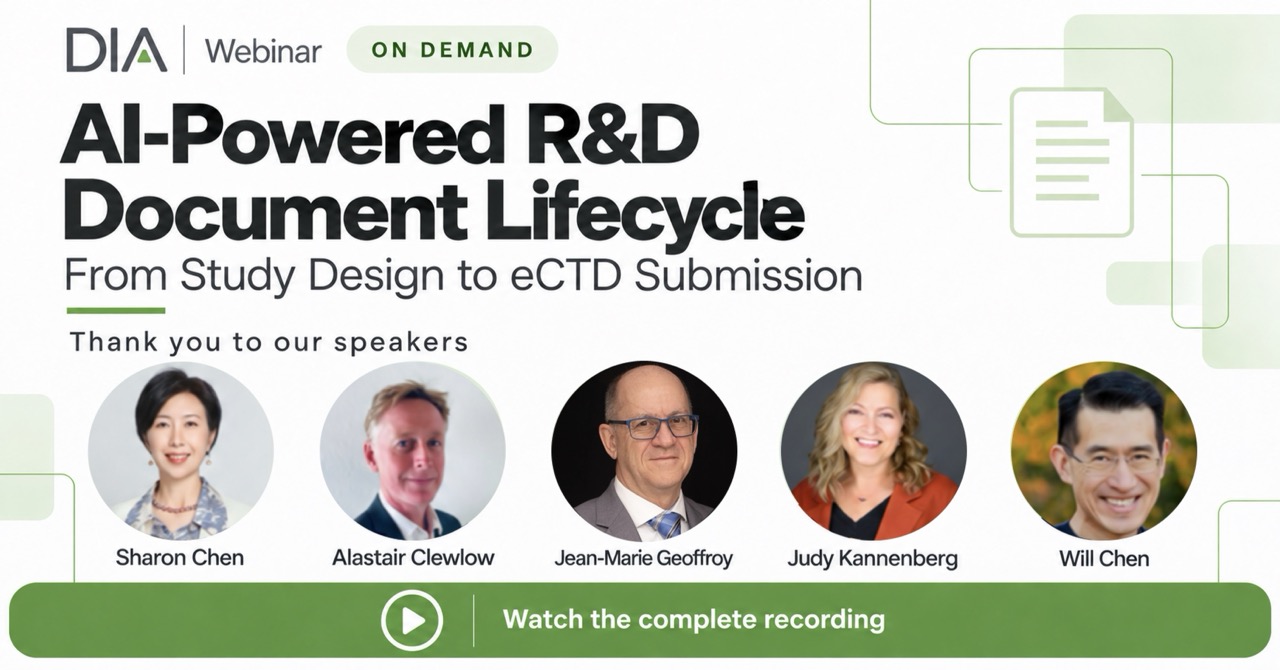
On September 17, 2026, AlphaLife Sciences presented the DIA webinar AI-Powered R&D Document Lifecycle: From Study Design to eCTD Submission — AI Tools Demo. The session paired workflow demonstrations with a discussion of how AI can support documentation across clinical development, chemistry, manufacturing, and controls (CMC), and labeling.
We thank Alastair Clewlow, Jean-Marie Geoffroy, and Judy Kannenberg for sharing their independent views and subject-matter insights. Each brought a distinct perspective on the opportunities and practical challenges of AI adoption. Thank you also to Sharon Chen and Will Chen for guiding the discussion and demonstrations, to DIA for hosting, and to everyone who participated and submitted questions.
Connect evidence and decisions across documents
Will Chen explored how study design decisions and source evidence flow into downstream documents. The AuroraPrime demonstrations covered clinical summaries, CMC authoring, and labeling, with examples of source tracing and reviewing proposed changes alongside supporting evidence.
One distinction was central: identifying that two documents are related is only a starting point. Authors also need to understand which sections depend on a source, what an update means, and whether a revision is appropriate. The change workflow presented moved from detecting a source update to assessing its impact and proposing targeted revisions for human review.
Evaluate AI through real work—and prepare for production
Alastair Clewlow described a practical approach to evaluating AI: use a previously completed clinical study report in a pilot, then ask the usual reviewers to assess the outputs without knowing which vendor produced them. That approach puts the quality and usefulness of the resulting document at the center of the evaluation.
He also highlighted the work involved in moving from a pilot to production. Involving stakeholders throughout the process, checking each workflow step, and giving people dedicated time to prepare were important lessons from his experience. Confidence in a first document type can support expansion, but adoption requires attention to how teams actually work.
Give CMC authoring the context it needs
Jean-Marie Geoffroy emphasized that CMC documentation must bring large volumes of information from different functions into a coherent, defensible scientific account. AI needs context, metadata, and a clear understanding of the purpose of each section within the submission. Where workflows are less mature, a strategy document can help clarify the intended argument and expected output.
He also encouraged teams to assess value beyond the speed of a first draft. Quality, delivery, cost, and engagement all matter, including whether scientists gain more time to focus on the science and strategy. Expert review remains essential to determine whether generated content is fit for its intended purpose.
Manage labeling changes with regional context
Judy Kannenberg highlighted the complexity of maintaining labels across markets, formats, languages, and versions. Her perspective distinguished the near-term opportunity to support initial label drafts from the longer-term challenge of keeping global label families current as evidence changes.
She used a safety update to illustrate why consistency requires an understanding of regional differences. AI could help assess where changes may be needed and suggest language, while people must decide whether an update applies to every label or only to selected markets.
Keep human judgment and traceability central
In the audience Q&A, Jean-Marie stressed that accountability for the information and final output remains with people. He emphasized the ability to explain how a conclusion was reached and justify it through traceable evidence. Judy likewise highlighted decisions about whether labeling changes should be made as an area requiring human intervention.
Sharon Chen closed by encouraging teams to start with a real problem, demonstrate value across a complete workflow, and build the evidence and connections needed to scale. The discussion pointed toward a practical path for adoption: prepare the workflows, train the people using them, and define where expert judgment is required.
Watch the complete webinar
Missed the live session or want to revisit the discussion? Watch the complete DIA webinar recording for the demonstrations, guests’ perspectives, and audience Q&A.
