




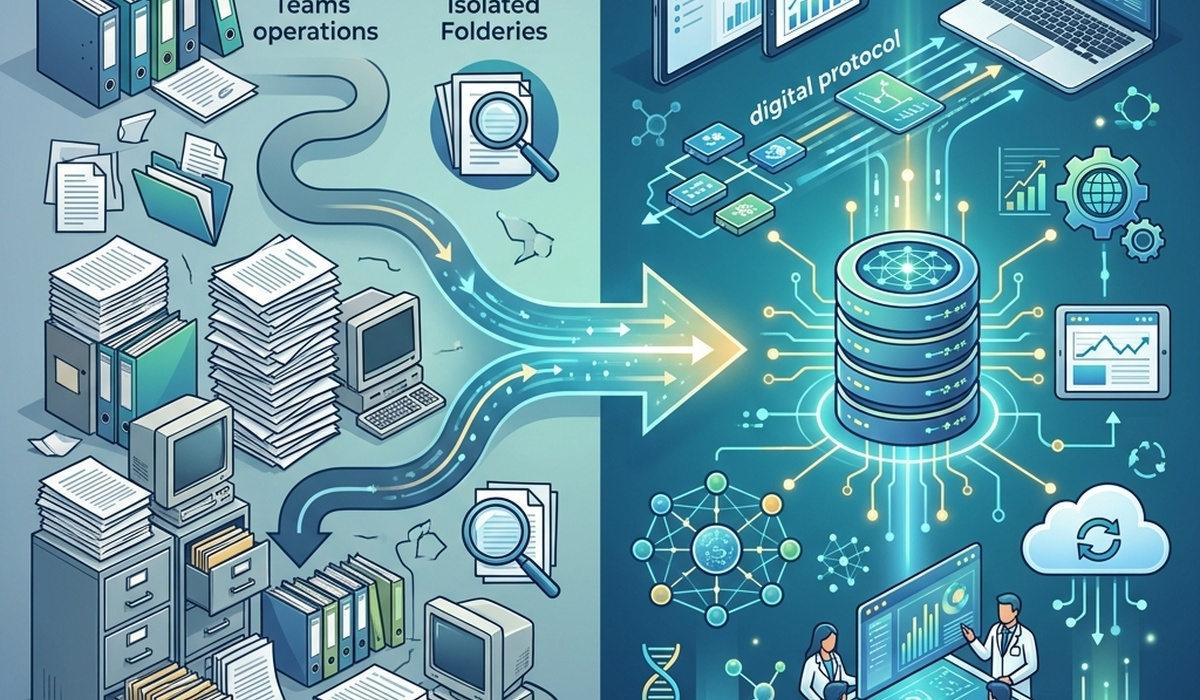
The Shift: Document-Centric vs. Data-Centric Trials
This article is for clinical operations leaders, biostatisticians, and regulatory affairs professionals who are navigating the complexity of modern submission timelines.
For decades, drug development has relied on static, siloed files. A protocol is drafted in Microsoft Word, data is collected in an EDC system, statisticians generate RTF tables, and medical writers assemble a Clinical Study Report (CSR) in another Word document. This document-centric approach leads to massive inefficiencies:
Manual copying and pasting of tables, figures, and listings (TFLs) introduces human error.
Traceability is lost between the raw database and the final clinical study report ai software.
Version control issues delay the final "race to submit" under tight regulatory windows.
By contrast, a data-centric workflow treats the protocol and data as structured objects. Documents are merely temporary representations of this underlying database.
How a Pharma R&D Document Automation Solution Bridges the Gap
An ai writing platform for life sciences like AuroraPrime RMA acts as the translation layer between raw trial data and polished documents. The platform ingests structured, semi-structured, and unstructured data from PDFs, RTF, Word, and Excel files. Using AI-driven semantic processing, it transforms these sources into structured, traceable outputs.
For example, when writing a CSR, AuroraPrime RMA does not just generate text—it parses RTF tables from biostatistics, converts them into structured tables within its database, and generates JSON formats to maintain exact mathematical and semantic relationships. This guarantees that every number in the text matches the source TFL.
USDM and CDISC: The Foundation of Data-Centric Architecture
To achieve true data-centricity, the industry must adopt standardized models:
USDM (Unified Study Definitions Model): AuroraPrime RMA supports USDM 4.0 structural skeletons. When designing a protocol, authors can initiation the project using USDM-compliant study designs, ensuring that study objectives, endpoints, and schedules of activities are stored as structured database elements.
CDISC (Clinical Data Interchange Standards Consortium): The platform enables seamless transitions into CDISC-compliant eCRF build processes, bridging the gap between protocol design and clinical database setup.
By enforcing these standards, a pharma R&D document automation solution ensures that downstream documents are automatically aligned with the source protocol without manual re-entry.
| Process Step | Document-Centric Method | Data-Centric (AuroraPrime RMA) | Time Saved |
|---|---|---|---|
| Protocol Setup | Manual Word templates | USDM 4.0 Structural Skeleton | 50% |
| TFL Integration | Copy-pasting RTF tables | Automated RTF/Excel Semantic Ingestion | 90% |
| CSR Drafting | Manual writing and cross-checking | AI-driven generation from structured JSON | 70% |
Clinical Study Report Automation in Action
In traditional medical writing, compiling a CSR requires weeks of cross-checking. Statisticians provide TFLs, and writers must manually describe these tables in the text.
With AuroraPrime RMA's clinical study report ai software, this workflow is condensed:
Direct TFL Ingestion: RTF files containing TFLs are uploaded and automatically parsed.
Real-time Conformance: The platform runs automated conformance checks against the protocol design and regulatory standards, highlighting missing fields or deviations.
Draft Generation: The AI engine uses writing instructions to draft section text directly from the parsed data tables, maintaining consistent terminology and professional tone.
By turning unstructured document tables into structured data, sponsors can reduce CSR writing cycles from months to days.
Pro Tip: Use customized RTF parsing templates within AuroraPrime RMA to reprocess tables if biostatistics outputs deviate from standard styles. This ensures 100% extraction accuracy without demanding code changes from programmers.
For more information on streamlining your regulatory workflow, visit our pharma regulatory ai writing tool page or book a demo.
Frequently Asked Questions
What is a pharma R&D document automation solution?
A pharma R&D document automation solution is a specialized software platform that uses artificial intelligence and semantic data processing to automate the creation, review, and formatting of clinical and regulatory documents, such as Protocols, Investigator Brochures, and Clinical Study Reports.
How does the transition from document-centric to data-centric work?
Instead of manually typing data into Word files, a data-centric workflow structure processes all clinical trial parameters (endpoints, schedules, tables) as database objects. The software then automatically populates and formats regulatory documents using these structured data models.
Does AuroraPrime RMA support USDM standards?
Yes, AuroraPrime RMA supports USDM 4.0 specifications, allowing sponsors to initiate trials using compliant study designs that sync directly with study definitions repositories and downstream electronic case report forms (eCRFs).
Conclusion
Transitioning to a data-centric trial model is no longer an optional upgrade—it is a competitive necessity. By deploying a specialized pharma R&D document automation solution like AuroraPrime RMA, biopharma sponsors can break down the silos between clinical data and medical writing. The result is faster authoring, zero-defect submissions, and a significantly reduced cycle time.
Ready to digitize your trial design and medical authoring? Contact us to schedule a demo.
